Event submissions
EventsThe 2nd International Electronic Conference on Medicinal Chemistry and Pharmaceutics
Published
This submission belongs to the session S3. New Small Molecules as Drug Candidates of the event The 2nd International Electronic Conference on Medicinal Chemistry and Pharmaceutics
Published date
28 Oct, 2026
Academic Editor
 Mary J. Meegan
Contribution&Funding
Methodology,
[Amra Džambić] ; [Maida Šljivić Husejnović ] ; [Demir Bjelošević]
Software,
[Amra Džambić] ; [Demir Bjelošević]
Validation,
[Maida Šljivić Husejnović ]
Formal analysis,
[Darja Husejnagić] ; [Emir Horozić]
Writing - original draft,
[Amra Džambić] ; [Ajla Begić]
Writing - review,
[editing] ; [Demir Bjelošević]
Supervision,
[Samija Muratović]
Funding: --
Citation
Amra Džambić, Samija Muratović, Maida Šljivić Husejnović , Demir Bjelošević, Darja Husejnagić, Ajla Begić, Emir Horozić, Synthesis of tetraketones and determination their biological activity, in Proceedings of The 2nd International Electronic Conference on Medicinal Chemistry and Pharmaceutics, 1 November–30 November 2026, MDPI: Basel, Switzerland
Share
Email
Facebook
Twitter
LinkedIn
Synthesis of tetraketones and determination their biological activity

Amra Džambić 1
Samija Muratović 2
Maida Šljivić Husejnović 3
Demir Bjelošević 1
Darja Husejnagić 4
Ajla Begić 5
Emir Horozić 6
1. Pharmaceutical chemistry, Faculty of Pharmacy, University of Tuzla, Tuzla, 75000, Bosnia and Herzegovina
2. Pharmaceutical chemistry, Faculty of Pharmacy, University of Sarajevo, Sarajevo, 71000, Bosnia and Herzegovina
3. Pharmaceutical analytics, Faculty of Pharmacy, University of Tuzla, Tuzla, 75000, Bosnia and Herzegovina
4. Department of Biology, Faculty of Mathematics and Natural sciences, University of Tuzla, Tuzla, 75000, Bosnia and Herzegovina
5. Pharmacy, Faculty of Pharmacy, University of Tuzla, Tuzla, 75000, Bosnia and Herzegovina
6. Organic chemistry, Faculty of Technology, University of Tuzla, Tuzla, 75000, Bosnia and Herzegovina
Abstract
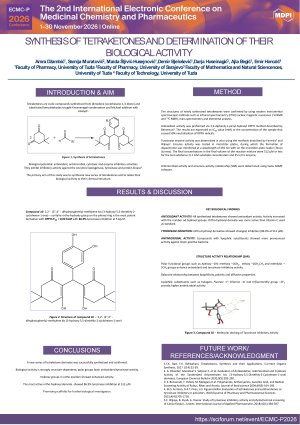
Tetraketones are cyclic compounds, synthetised from dimedone (cyclohexane-1,3-dione) and benyaldehydes via Knoevenegel condenzation and Michaels addition, by principles of green chemistry with catalyst. They are very interesting because they have wide range of biological activity such as antioxidant activity and inhibitory activity against enzymes lopoxygenase, tyrosinase and protein kinase. It has been determined that have strong cytotoxic as well as antimicrobial activity. The primary aim of this study was to synthesize new series of tetraketones and to relate their biologcal activity to chemical structure. Results showed that all synthesized tetraketones have different antioxidant activity, compounds with hydroxyl group in the structure were responsible for the strongest activity, also we found the correlation between the number of gropus and activity. Compound with ortho hydroxyl groups in the phenyl ring proved to be strongest antioxidant and has stronger activity than vitamin C. They also act as strong inhibitors of the enzyme tyrosinase, the most potent compound is with ortho hydroxyl groups in the ring, at the concentration of 512 μM inhibits tyrosinase activity of 86,9%, other compounds show weaker inhibitory activity. Stronger antimicrobial activity have compounds with lipophilic aromatic substituents, SAR analysis suported by SwissADME parameters indicated that the observed antimicrobial activity deepends on balanced relationship between lipophilicity, polarity and diffusion properties of the molecules. There is a correlation between biological activity and structure of tetraketones, compounds with polar funcional groups such as hydroxy, methoxy and ethoxy have stronger antioxidant activity and inhibitory activity against tyrosinase; compounds with lipophilic substituents such as fluorine, chlorine and trifluoromethly have better antimicrobial activity.
Keywords
Tetraketones
antioxidant activity
cytotoxicity
SAR
antimicrobial activity
Poster
Poster - A. Džambić.pdf
Pyruvic Acid 4-Allylthiosemicarbazone and Its Metal Complexes as Agents for Free Radical Neutralization
Development of Novel Enantiopure Aminopyridine Alcohols as Promising Antimalarial Agents