Event submissions
EventsThe 2nd International Electronic Conference on Medicinal Chemistry and Pharmaceutics
Published
This submission belongs to the session S3. New Small Molecules as Drug Candidates of the event The 2nd International Electronic Conference on Medicinal Chemistry and Pharmaceutics
Published date
28 Oct, 2026
Academic Editor
 Mary J. Meegan
Contribution&Funding
Conceptualization,
[Suraj N. Mali]
Methodology,
[Suraj N. Mali] ; [Rakesh Somani]
Software,
[Suraj N. Mali] ; [Rakesh Somani]
Validation,
[Rakesh Somani]
Writing - original draft,
[Suraj N. Mali] ; [Akash Sanjay Pandey]
Writing - review,
[editing] ; [Suraj N. Mali] ; [Akash Sanjay Pandey]
Supervision,
[Rakesh Somani]
Funding: --
Citation
Suraj N. Mali, Akash Sanjay Pandey, Rakesh Somani, Design, Synthesis, Biological Evaluation, and Computational Investigation of 2,7-Dimethylimidazo[1,2-a]pyridine-3-carboxamide Derivatives as Novel α-Amylase Inhibitors, in Proceedings of The 2nd International Electronic Conference on Medicinal Chemistry and Pharmaceutics, 1 November–30 November 2026, MDPI: Basel, Switzerland
Share
Email
Facebook
Twitter
LinkedIn
Design, Synthesis, Biological Evaluation, and Computational Investigation of 2,7-Dimethylimidazo[1,2-a]pyridine-3-carboxamide Derivatives as Novel α-Amylase Inhibitors

Suraj N. Mali 1
Akash Sanjay Pandey 1
Rakesh Somani 1
1. Pharmaceutical chemistry, School of Pharmacy, D. Y. Patil University (Deemed to Be University), Navi Mumbai, Maharashtra, 400706, India
Abstract
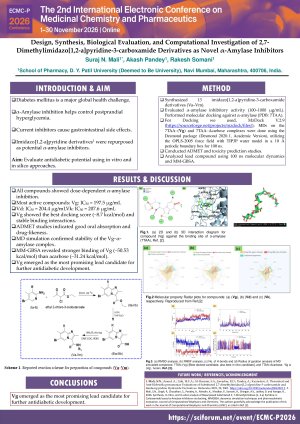
A series of substituted 2,7-dimethylimidazo[1,2-a]pyridine-3-carboxamide derivatives (Va–Vm) was synthesized and evaluated for their α-amylase inhibitory activity as potential antidiabetic agents. In vitro screening identified Vg, Vd, and Vk as the most active derivatives, with IC₅₀ values of 197.5, 204.4, and 207.6 µg/mL, respectively, compared with 66.65 µg/mL for the reference inhibitor acarbose. Molecular docking studies against α-amylase revealed favorable binding affinities for the synthesized derivatives, ranging from −7.4 to −8.7 kcal/mol. Among the tested compounds, Vg exhibited the most favorable binding profile, engaging key catalytic and binding-site residues through hydrophobic, hydrogen-bonding, π–π stacking, halogen-bonding, and π–cation interactions. The stability of the Vg–α-amylase complex was further investigated by 100 ns molecular dynamics simulations, which demonstrated sustained ligand binding, limited structural fluctuations, and stable protein–ligand interactions throughout the simulation. MM/GBSA calculations further supported the favorable binding free energy of the lead compounds. In silico ADME profiling predicted favorable pharmacokinetic characteristics, including high gastrointestinal absorption, low topological polar surface area, blood–brain barrier permeability, and compliance with Lipinski’s rule of five. Furthermore, toxicity prediction indicated no major safety liabilities. Overall, the integrated experimental and computational results identify substituted 2,7-dimethylimidazo[1,2-a]pyridine-3-carboxamides, particularly Vg, as promising lead structures for further optimization and development as α-amylase inhibitors for potential application in diabetes management.
Keywords
2,7-Dimethylimidazo[1,2-a]pyridine-3-carboxamide
Molecular docking
Dynamics
Anti-diabetics
Poster
Final Poster_Mali.pdf
Development of Novel Enantiopure Aminopyridine Alcohols as Promising Antimalarial Agents
Aloin and Its Metabolite Modulate Prognosis and Immune Microenvironment in Head and Neck Squamous Cell Carcinoma via Gut Microbiota Metabolite-Related Targets