Event submissions
EventsThe 2nd International Electronic Conference on Medicinal Chemistry and Pharmaceutics
Published
This submission belongs to the session S3. New Small Molecules as Drug Candidates of the event The 2nd International Electronic Conference on Medicinal Chemistry and Pharmaceutics
Published date
28 Oct, 2026
Academic Editor
 Maria Emília Sousa
Contribution&Funding
Funding: the Youth Science and Technology Talent Program in Health and Wellness, Xinjiang Uygur Autonomous Region (grant no. WJWY‑202423)
Citation
Wenjuan Li, Xuexian Wu, Dan Wang, Yeliban Abulimiti, Ayouxi A, Kunpeng Wang, Aloin and Its Metabolite Modulate Prognosis and Immune Microenvironment in Head and Neck Squamous Cell Carcinoma via Gut Microbiota Metabolite-Related Targets, in Proceedings of The 2nd International Electronic Conference on Medicinal Chemistry and Pharmaceutics, 1 November–30 November 2026, MDPI: Basel, Switzerland
Share
Email
Facebook
Twitter
LinkedIn
Aloin and Its Metabolite Modulate Prognosis and Immune Microenvironment in Head and Neck Squamous Cell Carcinoma via Gut Microbiota Metabolite-Related Targets

Wenjuan Li 1
Xuexian Wu 1
Dan Wang 2
Yeliban Abulimiti 1
Ayouxi A 1
Kunpeng Wang 1,2
1. Department of Stomatology, The Friendship Hospital of Ili Kazakh Autonomous Prefecture, China
2. Department of Stomatology, Hetian Prefecture People's Hospital, Hotan , China
Abstract
Aloin modulates the composition and function of the gut microbiota, and gut microbiota can also convert aloin to aloe-emodin, which may further contribute to its biological effects. Additionally, gut microbiota-derived metabolites are known to shape the immune microenvironment of head and neck squamous cell carcinoma (HNSCC) via the “gut-immune axis.” However, whether aloin and its metabolite affect HNSCC prognosis and immune landscape via gut microbiota metabolite-related gene targets remains unclear. In this study, aloin-related targets were retrieved from SwissTargetPrediction, CTD, and PharmMapper, and gut microbiota metabolite-regulated genes were obtained from gutMGene. Using the TCGA-HNSCC cohort, a risk score signature was constructed through univariate Cox, LASSO, and multivariate Cox, and its independent prognostic value was evaluated after adjusting for clinical covariates. Associations between risk score and immune cell infiltrates were assessed, along with KEGG enrichment and molecular docking. Intersection yielded 29 common targets, from which six hub genes were identified to build a risk score signature: Risk score = (-0.1324)×BCL2 + (0.2392)×PPARG + (0.1031)×NQO1 + (0.2453)×APP + (-0.0657)×LYZ + (0.0367)×EGFR. Multivariate Cox confirmed the risk score as an independent prognostic factor for HNSCC (P < 0.05). Immune infiltration analysis showed that the risk score positively correlated with CD4+ T cells, central memory T cells, follicular helper T cells, and macrophages, and negatively with effector memory T cells and neutrophils (P < 0.05). KEGG enrichment revealed significant enrichment in HIF-1, JAK-STAT, PPAR and PD-L1/PD-1 checkpoint pathways. Molecular docking revealed that aloin and aloe-emodin bound to PPARG (PDB: 8B95; -8.4/-8.6 kcal/mol) and APP (PDB: 2FK1; -5.3/ -5.2 kcal/mol), supporting their multi-target potential. Collectively, aloin and its metabolite may influence HNSCC prognosis and immune microenvironment potentially through the gut-immune axis, offering a theoretical basis for prognostic assessment and aloin-based therapeutic strategies.
Keywords
Aloin; gut microbiota; head and neck squamous cell carcinoma; prognostic signature; tumor immune microenvironment
Poster
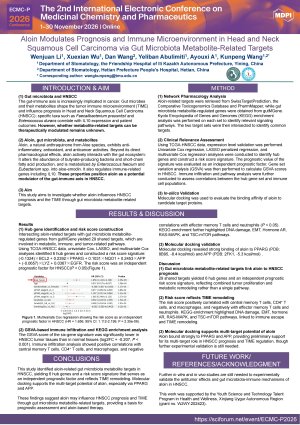
Poster-Aloin Modulates Prognosis and Immune Microenvironment in Head and Neck Squamous Cell Carcinoma via Gut Microbiota Metabolite-Related Targets.pdf
Design, Synthesis, Biological Evaluation, and Computational Investigation of 2,7-Dimethylimidazo[1,2-a]pyridine-3-carboxamide Derivatives as Novel α-Amylase Inhibitors
Computational Multi‑Target Profiling of Euphorbia Metabolites as Promising Anti‑Cancer Candidates