Event submissions
EventsThe 2nd International Electronic Conference on Medicinal Chemistry and Pharmaceutics
Published
This submission belongs to the session S3. New Small Molecules as Drug Candidates of the event The 2nd International Electronic Conference on Medicinal Chemistry and Pharmaceutics
Published date
28 Oct, 2026
Academic Editor
 Maria Emília Sousa
Contribution&Funding
Conceptualization,
[Christian Ruben HualtibambaGonzales] ; [Víctor Eduardo Villarreal La Torre]
Methodology,
[Christian Ruben HualtibambaGonzales] ; [Víctor Eduardo Villarreal La Torre]
Software,
[Christian Ruben HualtibambaGonzales] ; [Víctor Eduardo Villarreal La Torre]
Validation,
[Christian Ruben HualtibambaGonzales] ; [Víctor Eduardo Villarreal La Torre]
Formal analysis,
[Christian Ruben HualtibambaGonzales] ; [Víctor Eduardo Villarreal La Torre]
Investigation,
[Christian Ruben HualtibambaGonzales] ; [Víctor Eduardo Villarreal La Torre]
Resources,
[Víctor Eduardo Villarreal La Torre]
Data curation,
[Víctor Eduardo Villarreal La Torre]
Writing - original draft,
[Christian Ruben HualtibambaGonzales]
Writing - review,
[editing] ; [Víctor Eduardo Villarreal La Torre]
Visualization,
[Christian Ruben HualtibambaGonzales]
Supervision,
[Víctor Eduardo Villarreal La Torre]
Funding: --
Citation
Christian Ruben HualtibambaGonzales, Víctor Eduardo Villarreal La Torre, Computational Multi‑Target Profiling of Euphorbia Metabolites as Promising Anti‑Cancer Candidates, in Proceedings of The 2nd International Electronic Conference on Medicinal Chemistry and Pharmaceutics, 1 November–30 November 2026, MDPI: Basel, Switzerland
Share
Email
Facebook
Twitter
LinkedIn
Computational Multi‑Target Profiling of Euphorbia Metabolites as Promising Anti‑Cancer Candidates

Christian Ruben HualtibambaGonzales 1

Víctor Eduardo Villarreal La Torre 1
1. Bioinformatic and Cheminformatics Group, National University of Trujillo, La Libertad, 13011, Peru
Abstract
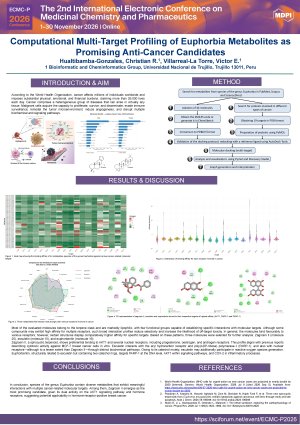
Background. According to the World Health Organization, cancer affects millions of individuals worldwide and imposes substantial physical, emotional, and financial burdens, claiming more than 26,000 lives each day. Cancer comprises a heterogeneous group of diseases that can arise in virtually any tissue.
Aim. Identifying metabolites derived from Euphorbia as potential therapeutic candidates for cancer treatment through in silico molecular docking.
Method. Euphorbia metabolites(44) were searched for (PubMed, ScienceDirect, Scopus), and their SMILES strings were obtained from PubChem or generated using ChemSketch. Nineteen cancer-related proteins from the PDB were selected and visualised in PyMOL. Multi-target docking was performed using AutoDock Vina 1.2.5 (boxes defined in AutoDockTools 1.5.7), and the results were analysed in PyMOL and Discovery Studio.
Results. In general, the molecules bind favourably to various receptors; however, certain structures display comparatively higher affinity for specific targets. Based on these patterns, three molecules were selected for further analysis: Zagrosin II (molecule 25), esculetin (molecule 15), and euphorbentin (molecule 16). Zagrosin II, a spirocyclic terpenoid, shows preferential binding to AKT1 and several nuclear receptors, including progesterone, oestrogen, and androgen receptors. Esculetin interacts with the aryl hydrocarbon receptor and PARP‑1, and also with nuclear receptors—although to a lesser extent than Zagrosin II—through distinct biochemical pathways. Owing to its catechol moiety, esculetin may additionally participate in reactive oxygen species generation. Euphorbentin, structurally related to esculetin but containing two catechol rings, targets PARP‑1 at the DNA level, AKT1 within signalling pathways, and COX‑2 in inflammatory processes.
Conclusions. Species of the genus Euphorbia contain diverse metabolites that exhibit meaningful interactions with multiple cancer‑related molecular targets. Among them, Zagrosin II emerges as the most promising candidate, given its dual activity on the AKT1 signalling pathway and hormone receptors, suggesting potential applicability in hormone‑receptor‑positive breast cancer.
Keywords
Euphorbia
Molecular docking
cancer
Zagrosin II
Poster
Poster-cancerR.pdf
Aloin and Its Metabolite Modulate Prognosis and Immune Microenvironment in Head and Neck Squamous Cell Carcinoma via Gut Microbiota Metabolite-Related Targets
Sulfonamide- and Coumarin-Tethered Acylhydrazones: Synthesis and Human Carbonic Anhydrases Inhibitory Activity