Event submissions
EventsThe 2nd International Electronic Conference on Medicinal Chemistry and Pharmaceutics
Published
This submission belongs to the session S3. New Small Molecules as Drug Candidates of the event The 2nd International Electronic Conference on Medicinal Chemistry and Pharmaceutics
Published date
28 Oct, 2026
Academic Editor
 Mary J. Meegan
Contribution&Funding
Investigation,
[Martin Josue Torres Castaño] ; [Macarena Soledad Le Pors]
Writing - original draft,
[Martin Josue Torres Castaño]
Writing - review,
[editing] ; [Pedro Alfonso Colinas]
Supervision,
[Macarena Soledad Le Pors] ; [Pedro Alfonso Colinas]
Funding acquisition,
[Pedro Alfonso Colinas]
Funding: --
Citation
Martin Josue Torres Castaño, Macarena Soledad Le Pors, Pedro Alfonso Colinas, Sulfonamide- and Coumarin-Tethered Acylhydrazones: Synthesis and Human Carbonic Anhydrases Inhibitory Activity, in Proceedings of The 2nd International Electronic Conference on Medicinal Chemistry and Pharmaceutics, 1 November–30 November 2026, MDPI: Basel, Switzerland
Share
Email
Facebook
Twitter
LinkedIn
Sulfonamide- and Coumarin-Tethered Acylhydrazones: Synthesis and Human Carbonic Anhydrases Inhibitory Activity

Martin Josue Torres Castaño 1
Macarena Soledad Le Pors 1
Pedro Alfonso Colinas 1
1. GICAR-CEDECOR Departamento de Química, Universidad Nacional de La Plata, La Plata, 1900, Argentina
Abstract
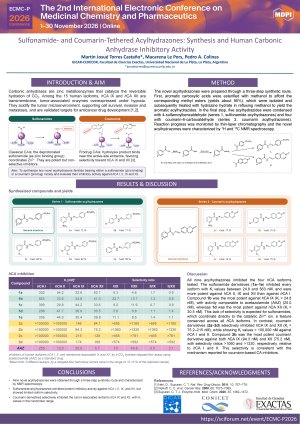
Carbonic anhydrases (CAs) are zinc metalloenzymes catalyzing the reversible hydration of CO₂. Among the 15 human isoforms, hCA IX and hCA XII are transmembrane, tumor-associated enzymes overexpressed under hypoxic conditions. These isoforms promote extracellular acidification in the tumor microenvironment, facilitating cell survival, invasion, and metastasis, and have thus been validated as antitumor drug targets[1]. However, achieving selectivity for these isoforms over the cytosolic hCA I and hCA II remains a major challenge.
Sulfonamide derivatives constitute classical CA inhibitors (CAIs), with the deprotonated sulfonamide nitrogen coordinating the Zn+2 ion in the active site. Coumarins act as prodrug CAIs, with their hydrolysis products binding at the variable active-site entrance and conferring isoform selectivity toward hCA IX and hCA XII.[2]
Herein, we report the synthesis of two novel acylhydrazone families. The synthetic route began with the esterification of five aromatic carboxylic acids with methanol; followed by treatment of the resulting methyl esters with hydrazine hydrate to afford the corresponding acylhydrazides. Condensation of four aromatic acylhydrazides with coumarin-6-carboxaldehyde and five with 4-sulfamoylbenzaldehyde afforded nine novel acylhydrazones, which were characterized and evaluated for their inhibitory activity against hCA I, II, IX, and XII using a stopped-flow CO₂ hydration assay. All compounds showed potent inhibition of the four evaluated hCA isoforms, with Ki values in the micromolar to nanomolar range, whereas the coumarin-derived acylhydrazones displayed pronounced selectivity for the tumor-associated CA IX (>1000) and XII (>1300).
[1] Neri, D.; Supuran, C. T. Interfering with pH regulation in tumours as a therapeutic strategy. Nat. Rev. Drug Discov. 2011, 10, 767–778.
[2] Supuran, C. T. Coumarin carbonic anhydrase inhibitors from natural sources. J. Enzyme Inhib. Med. Chem. 2020, 35, 1462–1472.
Keywords
Acylhydrazones
Coumarins
Sulfonamides
Carbonic Anhydrase
Poster
TorresCastañoMartinJosue_Poster_ECMC2026.pdf
Computational Multi‑Target Profiling of Euphorbia Metabolites as Promising Anti‑Cancer Candidates
In silico identification of EGFR tyrosine kinase inhibitors for glioblastoma