Event submissions
EventsThe 2nd International Electronic Conference on Medicinal Chemistry and Pharmaceutics
Published
This submission belongs to the session S3. New Small Molecules as Drug Candidates of the event The 2nd International Electronic Conference on Medicinal Chemistry and Pharmaceutics
Published date
28 Oct, 2026
Academic Editor
 Alfredo Berzal-Herranz
Contribution&Funding
Funding: This work received no funding.
Citation
Corina Stefania Matei, George Mihai Nitulescu, In silico identification of EGFR tyrosine kinase inhibitors for glioblastoma, in Proceedings of The 2nd International Electronic Conference on Medicinal Chemistry and Pharmaceutics, 1 November–30 November 2026, MDPI: Basel, Switzerland
Share
Email
Facebook
Twitter
LinkedIn
In silico identification of EGFR tyrosine kinase inhibitors for glioblastoma

Corina Stefania Matei 1,2

George Mihai Nitulescu 1
1. Faculty of Pharmacy, “Carol Davila” University of Medicine and Pharmacy, Bucharest, Romania
2. Clinical Toxicology Laboratory, Cantacuzino National Military Medical Institute for Research and Development, Bucharest, Romania
Abstract
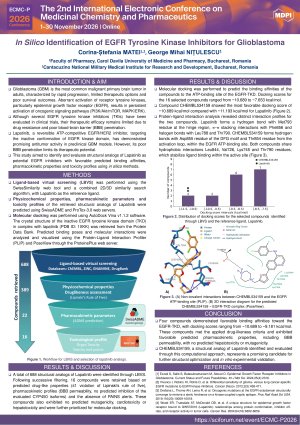
Glioblastoma (GBM) is the most common malignant primary brain tumor in adults and is characterized by rapid progression, limited therapeutic options and poor survival outcomes. Aberrant activation of receptor tyrosine kinases (RTKs), particularly epidermal growth factor receptor (EGFR), results in persistent activation of oncogenic signalling pathways promoting tumorigenesis, disease progression and therapeutic resistance. Although several RTK inhibitors have been evaluated in clinical trials for GBM, their therapeutic efficacy remains limited by challenges such as the development of drug resistance and low blood-brain barrier (BBB) penetration. This study aimed to identify potential EGFR tyrosine kinase inhibitors using various in silico methods. Ligand-based virtual screening of chemical databases was performed using the SwissSimilarity web tool, applying a combined 2D-fingerprint and 3D-shape similarity search algorithm. Lapatinib, a dual EGFR/HER2 tyrosine kinase inhibitor that binds to the inactive-like conformation of EGFR kinase domain, was used as the reference ligand for similarity searching. A total of 688 structural analogs of lapatinib were subsequently retrieved and evaluated for physicochemical properties, pharmacokinetic parameters, drug-likeness and toxicity using SwissADME and ProTox 3.0 web servers. A subset of 16 compounds exhibiting favorable predicted pharmacokinetic and safety profiles, BBB penetration and drug-like characteristics were prioritized for molecular docking. Molecular docking was performed using AutoDock Vina to estimate the binding affinities of selected compounds to the target protein. Predicted binding poses and molecular interactions were visualized using PyMOL. Molecular docking revealed several compounds with favorable binding affinities to the target protein and key molecular interactions within the EGFR tyrosine kinase domain. The compounds identified and evaluated through this computational approach represent promising candidates for further structural optimization and in vitro experimental validation.
Keywords
EGFR
tyrosine kinase inhibitors
glioblastoma
virtual screening
molecular docking
Poster
Poster ECMC-P 2026 - Matei Corina.pdf
Sulfonamide- and Coumarin-Tethered Acylhydrazones: Synthesis and Human Carbonic Anhydrases Inhibitory Activity
Influence of the aromatic substituent on the α-glucosidase inhibitory activity of D-ribose derived 1,2,3-triazoles