Event submissions
EventsThe 2nd International Electronic Conference on Medicinal Chemistry and Pharmaceutics
Published
This submission belongs to the session S3. New Small Molecules as Drug Candidates of the event The 2nd International Electronic Conference on Medicinal Chemistry and Pharmaceutics
Published date
28 Oct, 2026
Academic Editor
 Mary J. Meegan
Contribution&Funding
Conceptualization,
[Pedro Alfonso Colinas]
Investigation,
[Ignacio Aznar] ; [Macarena Soledad Le Pors]
Writing - original draft,
[Ignacio Aznar]
Writing - review,
[editing] ; [Macarena Soledad Le Pors] ; [Pedro Alfonso Colinas]
Supervision,
[Macarena Soledad Le Pors] ; [Pedro Alfonso Colinas]
Project administration,
[Pedro Alfonso Colinas]
Funding acquisition,
[Pedro Alfonso Colinas]
Funding: --
Citation
Ignacio Aznar, Macarena Soledad Le Pors, Pedro Alfonso Colinas, Influence of the aromatic substituent on the α-glucosidase inhibitory activity of D-ribose derived 1,2,3-triazoles, in Proceedings of The 2nd International Electronic Conference on Medicinal Chemistry and Pharmaceutics, 1 November–30 November 2026, MDPI: Basel, Switzerland
Share
Email
Facebook
Twitter
LinkedIn
Influence of the aromatic substituent on the α-glucosidase inhibitory activity of D-ribose derived 1,2,3-triazoles

Ignacio Aznar 1
Macarena Soledad Le Pors 1
Pedro Alfonso Colinas 1
1. GICAR-CEDECOR, Departamento de Química de la Facultad de Ciencias Exactas, Universidad Nacional de La Plata, La Plata, 1900, Argentina
Abstract
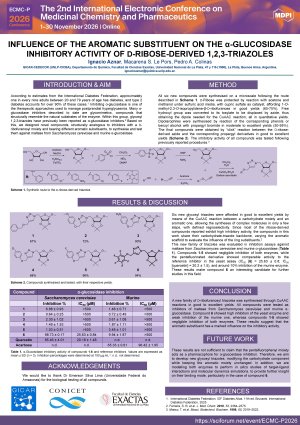
International Diabetes Federation estimates that 1 in 9 adults aged 20-79 years is living with diabetes; more than 90% of these cases correspond to type 2 diabetes.1 One therapeutic strategy for controlling postprandial hyperglycemia is the inhibition of α-glucosidase. Most known α-glucosidase inhibitors are glycomimetics that resemble the natural substrates of the enzyme, which facilitates their binding to the active site. Among them, carbohydrate-derived 1,2,3-triazoles have previously been reported as α-glucosidase inhibitors.2
On this basis, a new set of D-ribose-derived triazoles was synthesized and characterized. These compounds were designed to share the same carbohydrate-triazole core while differing only in the aromatic substituent. D-Ribose was protected as its 2,3-O-isopropylidene methyl glycoside leaving a free hydroxyl group at C-5. The protected sugar was then converted into the corresponding tosylate, which underwent nucleophilic displacement with azide to afford the 1,3-dipole. The dipolarophiles were prepared by O-propargylation of the corresponding phenols or benzyl alcohol with propargyl bromide. The target compounds were obtained in high yields through CuAAC reaction of both precursors in water/dichloromethane, using copper(II) sulfate and sodium ascorbate as the catalytic system.
All products were evaluated against maltase from Saccharomyces cerevisiae and murine α-glucosidase following previously reported procedures.3 The most active compound, derivative of pentafluorophenol, showed an IC50 value of 25.63 µM, comparable to that of the reference inhibitor quercetin (IC50 = 20 µM), while showing only slight inhibition of the murine enzyme (around 10%). The rest of the synthesized compounds showed negligible inhibition of the enzyme, with an IC50 > 500 µM.
1. International Diabetes Federation, 2026. https://idf.org/
2. Ferreira, S. B. et al. J. Med. Chem. 2010, 53, 2364–2375.
3. Matsui, T. et al. Biosci. Biotechnol. Biochem. 1996, 60 (12), 2019–2022.
Keywords
α-glucosidase
triazoles
carbohydrates
Poster
AznarI.pdf
In silico identification of EGFR tyrosine kinase inhibitors for glioblastoma
Structural characterization of vanadium binding to human serum transferrin