Event submissions
EventsThe 2nd International Electronic Conference on Medicinal Chemistry and Pharmaceutics
Published
This submission belongs to the session S3. New Small Molecules as Drug Candidates of the event The 2nd International Electronic Conference on Medicinal Chemistry and Pharmaceutics
Published date
28 Oct, 2026
Academic Editor
 Mary J. Meegan
Contribution&Funding
Conceptualization,
[Pietro Spanu] ; [Fausta Ulgheri]
Methodology,
[Fausta Ulgheri]
Validation,
[Fausta Ulgheri] ; [Pietro Spanu] ; [Giuseppina Sanna]
Formal analysis,
[Fausta Ulgheri] ; [Luca Virdis] ; [Giuseppina Sanna] ; [Antonio Dore] ; [Giovanni Loriga] ; [Andrea Beccu]
Investigation,
[Andrea Beccu] ; [Luca Virdis] ; [Giuseppina Sanna] ; [Giovanni Loriga] ; [Fausta Ulgheri]
Resources,
[Pietro Spanu] ; [Fausta Ulgheri]
Data curation,
[Giuseppina Sanna] ; [Luca Virdis] ; [Fausta Ulgheri] ; [Giovanni Loriga] ; [Antonio Dore] ; [Andrea Beccu]
Writing - original draft,
[Fausta Ulgheri]
Writing - review,
[editing] ; [Fausta Ulgheri] ; [Pietro Spanu]
Supervision,
[Fausta Ulgheri]
Project administration,
[Fausta Ulgheri] ; [Pietro Spanu]
Funding acquisition,
[Fausta Ulgheri]
Funding: NextGenerationEU-MUR PNRR – Mission 4 Component 2 – Extended Partnership initiative on Emerging Infectious Diseases (Project no. PE00000007, INF-ACT).
Citation
Fausta Ulgheri, Giovanni Loriga, Andrea Beccu, Antonio Dore, Giuseppina Sanna, Luca Virdis, Pietro Spanu, Mpro-Targeting Small Molecules and PROTACs with SARS-CoV-2 vs HCoV-OC43 Selectivity, in Proceedings of The 2nd International Electronic Conference on Medicinal Chemistry and Pharmaceutics, 1 November–30 November 2026, MDPI: Basel, Switzerland
Share
Email
Facebook
Twitter
LinkedIn
Mpro-Targeting Small Molecules and PROTACs with SARS-CoV-2 vs HCoV-OC43 Selectivity

Fausta Ulgheri 1
Giovanni Loriga 1
Andrea Beccu 1
Antonio Dore 2
Giuseppina Sanna 3
Luca Virdis 3
Pietro Spanu 1
1. Institute of Biomolecular Chemistry (ICB), Italian National Research Council (CNR), Sassari, 07100, Italy
2. Institute of Science of Food Production (ISPA), Italian National Research Council (CNR), Sassari, 07100, Italy
3. Biomedical Science, Section of Microbiology and Virology, University of Cagliari, Cagliari, 09042, Italy
Abstract
Coronaviruses remain a major global health threat, highlighting the need for broad-spectrum antiviral agents effective against both circulating and emerging viral pathogens. The structural and functional conservation of the main protease (Mpro) across coronaviruses makes it an attractive target for broad-spectrum antiviral development. Herein, we report the design, MCR-based synthesis, and biological evaluation of a novel class of non-covalent, non-peptidic Mpro-targeting compounds and their corresponding PROTACs derivatives as antivirals candidates against coronaviruses infections. Starting from a fragment-based drug discovery approach, a series of small molecules was designed and synthesized one-pot via a Ugi four-component reaction (U-4CR). The compounds were evaluated for SARS-CoV-2 Mpro inhibition and antiviral activity in cellular models. The most active compound inhibited Mpro and showed antiviral activity against SARS‑CoV‑2 in the low‑micromolar range, with no cytotoxicity. Notably, a closely related analogue differing by only one methyl group displayed complementary antiviral activity against HCoV-OC43 while being inactive against SARS-CoV-2, although enzymatically inhibiting Mpro albeit with reduced potency. This divergent profile was retained in the corresponding PROTAC derivative, which inhibited HCoV‑OC43 replication with the same low micromolar EC₅₀ but showed no measurable activity against SARS‑CoV‑2. Overall, these results demonstrate antiviral activity against two distinct human coronaviruses within a closely related series of Mpro-targeting compounds, supporting these compounds as a promising starting point for the development of pan-coronavirus antivirals. Structure-activity relationship (SAR) studies are underway to optimize antiviral potency and broaden the spectrum of activity to other coronaviruses beyond the two studied so far.
Keywords
Antivirals
Main Protease
Coronavirus
Multicomponent Reactions
Small Molecules
Protacs
Poster
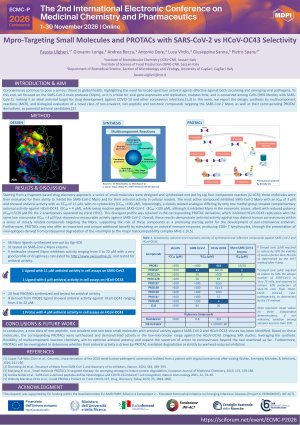
II ECMC-P 2026 Poster Ulgheri.pdf
Metallodrug-Protein Interactions at Physiological Temperature: Structural Insights from X-ray Crystallography at 37 °C
Structure-Based Discovery and Prioritization of Selective Tryptophan Hydroxylase 1 Inhibitors through Drug Repurposing for Hepatocellular Carcinoma