Event submissions
EventsThe 2nd International Electronic Conference on Medicinal Chemistry and Pharmaceutics
Published
This submission belongs to the session S3. New Small Molecules as Drug Candidates of the event The 2nd International Electronic Conference on Medicinal Chemistry and Pharmaceutics
Published date
28 Oct, 2026
Academic Editor
 Alfredo Berzal-Herranz
Contribution&Funding
Conceptualization,
[Radhika Khanna]
Methodology,
[Radhika Khanna]
Software,
[Radhika Khanna]
Validation,
[Radhika Khanna]
Formal analysis,
[Radhika Khanna]
Writing - original draft,
[Radhika Khanna]
Writing - review,
[editing] ; [Radhika Khanna]
Visualization,
[Radhika Khanna]
Supervision,
[Radhika Khanna]
Project administration,
[Radhika Khanna]
Funding: --
Citation
Radhika Khanna, From Metabolome to Molecule: Discovery of Bioactive Small-Molecule Drug Candidates from Cupressus torulosa D. Don, in Proceedings of The 2nd International Electronic Conference on Medicinal Chemistry and Pharmaceutics, 1 November–30 November 2026, MDPI: Basel, Switzerland
Share
Email
Facebook
Twitter
LinkedIn
From Metabolome to Molecule: Discovery of Bioactive Small-Molecule Drug Candidates from Cupressus torulosa D. Don

Radhika Khanna 1
1. chemistry and bioprospecting division, Forest Research Institute, dehradun, 248006, British Indian Ocean Territory
Abstract
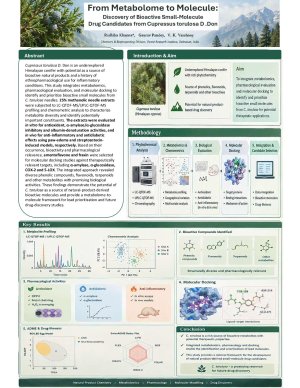
Cupressus torulosa D. Don is an underexplored Himalayan conifer with potential as a source of bioactive natural products and a history of ethnopharmacological use for inflammatory conditions. This study integrates metabolomics, pharmacological evaluation, and molecular docking to identify and prioritize bioactive small molecules from C. torulosa needles. 25% methanolic needle extracts were subjected to LC-QTOF-MS/UPLC-QTOF-MS profiling and chemometric analysis to characterize metabolite diversity and identify potentially important constituents. The extracts were evaluated in vitro for antioxidant, α-amylase/α-glucosidase inhibitory and albumin-denaturation activities, and in vivo for anti-inflammatory and antidiabetic effects using paw-edema and streptozotocin-induced models, respectively. Based on their occurrence, bioactivity and pharmacological relevance, amentoflavone and fraxin were selected for molecular docking studies against therapeutically relevant targets, including α-amylase, α-glucosidase, COX-2 and 5-LOX. The integrated approach revealed diverse phenolic compounds, flavonoids, terpenoids and other metabolites with promising biological activities. These findings demonstrate the potential of C. torulosa as a source of natural-product-derived bioactive molecules and provide a metabolome-to-molecule framework for lead prioritization and future drug-discovery studies.
Keywords
Cupressus torulosa; small-molecule drug candidates; natural products; metabolomics; UPLC-QTOF-MS; phytochemicals; molecular docking; drug discovery; pharmacological evaluation.
Poster
poster 22926.pdf
Structure-Based Discovery and Prioritization of Selective Tryptophan Hydroxylase 1 Inhibitors through Drug Repurposing for Hepatocellular Carcinoma
Synthesis, Structural Characterization and Biological Activity of Silver(I) Complexes with 1-Phenylimidazole