Event submissions
EventsThe 2nd International Electronic Conference on Medicinal Chemistry and Pharmaceutics
Published
This submission belongs to the session S3. New Small Molecules as Drug Candidates of the event The 2nd International Electronic Conference on Medicinal Chemistry and Pharmaceutics
Published date
28 Oct, 2026
Academic Editor
 Mary J. Meegan
Contribution&Funding
Conceptualization,
[Nevena Lj. Stevanović] ; [Biljana Đ. Glišić]
Methodology,
[Nevena Lj. Stevanović] ; [Tina P Andrejević] ; [Bojana Vučko Pantovic]
Software,
[Jakob Kljun]
Validation,
[Darko Asanin]
Investigation,
[Sanja Bogojevic] ; [Darko Asanin] ; [Tina P Andrejević]
Resources,
[Sanja Bogojevic] ; [Biljana Đ. Glišić]
Writing - original draft,
[Nevena Lj. Stevanović]
Visualization,
[Jakob Kljun] ; [Bojana Vučko Pantovic]
Supervision,
[Biljana Đ. Glišić]
Funding: --
Citation
Nevena Lj. Stevanović, Jakob Kljun, Sanja Bogojevic, Darko Asanin, Tina P Andrejević, Bojana Vučko Pantovic, Biljana Đ. Glišić, Synthesis, Structural Characterization and Biological Activity of Silver(I) Complexes with 1-Phenylimidazole, in Proceedings of The 2nd International Electronic Conference on Medicinal Chemistry and Pharmaceutics, 1 November–30 November 2026, MDPI: Basel, Switzerland
Share
Email
Facebook
Twitter
LinkedIn
Synthesis, Structural Characterization and Biological Activity of Silver(I) Complexes with 1-Phenylimidazole

Nevena Lj. Stevanović 1

Jakob Kljun 2
Sanja Bogojevic 3

Darko Asanin 4
Tina P Andrejević 1
Bojana Vučko Pantovic 1

Biljana Đ. Glišić 1
1. Faculty of Science, Department of Chemistry, University of Kragujevac, Kragujevac, 34000, Serbia
2. Faculty of Chemistry and Chemical Technology, University of Ljubljana, Ljubljana, SI-1000, Slovenia
3. Institute of Molecular Genetics and Genetic Engineering, University of Belgrade, Belgrade, 11042, Serbia
4. Institute for Information Technologies Kragujevac, Department of Science, University of Kragujevac, Kragujevac, 34000, Serbia
Abstract
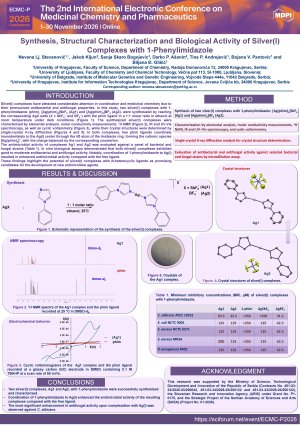
Silver(I) complexes have attracted considerable attention in coordination and medicinal chemistry due to their pronounced antibacterial and antifungal properties. In this study, two silver(I) complexes with 1-phenylimidazole (phim), [Ag(phim)2]SbF6 (Ag1) and [Ag(phim)2]BF4 (Ag2), were synthesized by reacting the corresponding AgX salts (X = SbF6– and BF4–) with the phim ligand in a 1 : 1 molar ratio in ethanol at room temperature in the absence of light. The synthesized silver(I) complexes were characterized by elemental analysis, molar conductivity measurement, 1H NMR, IR, and UV-Vis spectroscopy, and cyclic voltammetry, while their crystal structures were determined by single crystal X-ray diffraction. In both complexes, two phim ligands are coordinated to the Ag(I) center in a monodentate fashion through the N3 atom of the imidazole ring, forming the cationic [Ag(phim)2]+ species, which is charge-balanced by the corresponding counter-anion. The antimicrobial activity of complexes Ag1 and Ag2 was evaluated against a panel of bacterial and fungal strains, while their cytotoxicity was assessed using the normal human lung fibroblast cell line (MRC-5). In vitro biological assays demonstrated that both silver(I) complexes exhibit good to moderate antibacterial and antifungal activities. Notably, coordination of 1-phenylimidazole to Ag(I) enhanced its antimicrobial activity compared with the free ligand. These findings highlight the potential of silver(I) complexes containing N-heterocyclic ligands as promising candidates for the development of novel antimicrobial agents.
Keywords
Silver(I) complexes; 1-phenylimidazole; Structural characterization; Antimicrobial activity; Cytotoxicity.
Poster
ECMC_Nevena Stevanovic_.pdf
From Metabolome to Molecule: Discovery of Bioactive Small-Molecule Drug Candidates from Cupressus torulosa D. Don
Design, Synthesis and Biological Evaluation of 2-Methylthieno[2,3-d]pyrimidine Derivatives as Potential Cognitive-Modulating Agents