Event submissions
EventsThe 2nd International Electronic Conference on Medicinal Chemistry and Pharmaceutics
Published
This submission belongs to the session S3. New Small Molecules as Drug Candidates of the event The 2nd International Electronic Conference on Medicinal Chemistry and Pharmaceutics
Published date
28 Oct, 2026
Academic Editor
 Alfredo Berzal-Herranz
Citation
Rita P. Velhan, Hanna I. Severina, Sergiy V. Vlasov, Victoriya A. Georgiyants, Natalia I. Voloshchuk, Design, Synthesis and Biological Evaluation of 2-Methylthieno[2,3-d]pyrimidine Derivatives as Potential Cognitive-Modulating Agents, in Proceedings of The 2nd International Electronic Conference on Medicinal Chemistry and Pharmaceutics, 1 November–30 November 2026, MDPI: Basel, Switzerland
Share
Email
Facebook
Twitter
LinkedIn
Design, Synthesis and Biological Evaluation of 2-Methylthieno[2,3-d]pyrimidine Derivatives as Potential Cognitive-Modulating Agents

Rita P. Velhan 1

Hanna I. Severina 1
Sergiy V. Vlasov 2
Victoriya A. Georgiyants 1
Natalia I. Voloshchuk 3
1. Department of Pharmaceutical Chemistry, National university of pharmacy, Kharkiv, 61002, Ukraine
2. Department of Supramolecular Chemistry, Taras Shevchenko National University of Kyiv, Kyiv, 02094, Ukraine
3. Department of Pharmacology, National Pirogov Memorial Medical University, Vinnytsya, Ukraine
Abstract
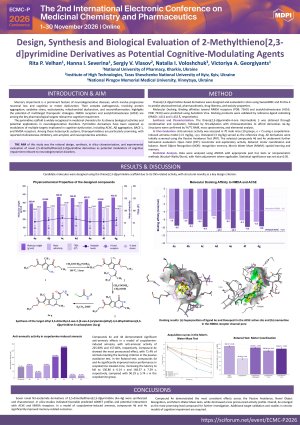
Cognitive impairment is a characteristic feature of neurodegenerative disorders and remains an important challenge in drug discovery. Thienopyrimidines represent a promising class of heterocyclic compounds with diverse biological activities and potential applications in the development of CNS-active agents. In this study, a series of 2-methylthieno[2,3-d]pyrimidin-4(3H)-one derivatives bearing an acetamide fragment at position 3 was designed, synthesized, and evaluated as potential cognitive-modulating agents.
The synthesized compounds were characterized by spectroscopic and analytical methods and subjected to in silico ADMET profiling. Molecular docking was performed to investigate their potential interactions with acetylcholinesterase (AChE) and the NMDA receptor, two targets involved in cognitive function. The derivatives demonstrated favorable predicted interactions with both targets, and compounds 4d and 4e were selected for extended biological evaluation.
The compounds were evaluated in a scopolamine-induced model of cognitive impairment in mice. Behavioral assessment included the Passive Avoidance Test, Open Field Test, Rotarod Test, Novel Object Recognition Test, and Morris Water Maze. Initial screening identified derivatives 4d and 4e as the most active representatives of the series. Among them, compound 4e demonstrated the most consistent behavioral effects, improving recognition memory and spatial learning and memory without evidence of generalized locomotor stimulation.
Overall, compound 4e was identified as a promising lead within this thieno[2,3-d]pyrimidine series, supporting further medicinal chemistry optimization and mechanistic investigation.
Keywords
thieno[2,3-d]pyrimidines; cognitive impairment; molecular docking; acetylcholinesterase; NMDA receptor; scopolamine
Poster
SciForum_Severina_Poster.pdf
Synthesis, Structural Characterization and Biological Activity of Silver(I) Complexes with 1-Phenylimidazole
In vivo genotoxic and antigenotoxic effects of a selected pyrazole-chromeno[2,3-d]pyrimidine derivative in Wistar rats