Event submissions
EventsThe 2nd International Electronic Conference on Medicinal Chemistry and Pharmaceutics
Published
This submission belongs to the session S3. New Small Molecules as Drug Candidates of the event The 2nd International Electronic Conference on Medicinal Chemistry and Pharmaceutics
Published date
28 Oct, 2026
Academic Editor
 Mary J. Meegan
Citation
Tamara M. Mladenović, Dušica M. Simijonović, Sanja Lj. Matić, In vivo genotoxic and antigenotoxic effects of a selected pyrazole-chromeno[2,3-d]pyrimidine derivative in Wistar rats
, in Proceedings of The 2nd International Electronic Conference on Medicinal Chemistry and Pharmaceutics, 1 November–30 November 2026, MDPI: Basel, Switzerland
Share
Email
Facebook
Twitter
LinkedIn
In vivo genotoxic and antigenotoxic effects of a selected pyrazole-chromeno[2,3-d]pyrimidine derivative in Wistar rats

Tamara M. Mladenović 1
Dušica M. Simijonović 1
Sanja Lj. Matić 1
1. Department of Science, Institute for Information Technologies, University of Kragujevac, Kragujevac, 34000, Serbia
Abstract
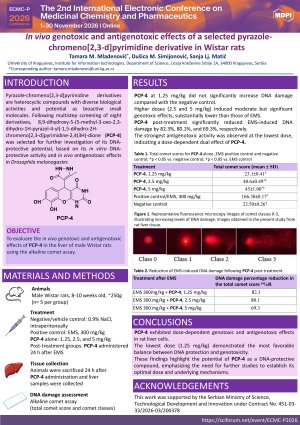
Pyrazole-chromeno[2,3-d]pyrimidine derivatives are heterocyclic compounds with diverse biological activities and potential as bioactive small molecules. Following multistep screening of eight derivatives, 8,9-dihydroxy-5-(5-methyl-3-oxo-2,3-dihydro-1H-pyrazol-4-yl)-1,5-dihydro-2H-chromeno[2,3-d]pyrimidine-2,4(3H)-dione (PCP-4) was selected for further investigation of its DNA-protective potential, based on its in vitro DNA-protective activity and in vivo antigenotoxic effects in Drosophila melanogaster. Its in vivo genotoxic and antigenotoxic effects were evaluated in the liver of male Wistar rats using the alkaline comet assay. Eight groups (n = 5/group; 8-10 weeks old; approximately 250 g) received 0.9% NaCl intraperitoneally as the negative/vehicle control, EMS alone (300 mg/kg), PCP-4 alone (1.25, 2.5, or 5 mg/kg), and PCP-4 administered 24 h after EMS treatment. Animals were sacrificed 24 h after PCP-4 administration, and liver samples were collected for DNA damage assessment. PCP-4 at 1.25 mg/kg did not significantly increase DNA damage, whereas 2.5 and 5 mg/kg produced moderate but significant increases. Total comet scores for PCP-4 alone were 23.10 ± 0.41, 40.60 ± 0.49, and 45.00 ± 1.00, respectively, compared with 166.30 ± 0.17 for EMS alone. Although higher PCP-4 doses showed intrinsic genotoxicity, the magnitude of DNA damage remained markedly lower than that produced by EMS under these conditions. Post-treatment with PCP-4 significantly reduced EMS-induced DNA damage by 82.3%, 80.1%, and 69.3%, respectively. These findings reveal a dose-dependent dual response, with pronounced antigenotoxic activity at lower doses and increased intrinsic genotoxicity at higher doses. Further studies are needed to determine the optimal protective dose of PCP-4 and elucidate the mechanisms underlying its dose-dependent effects.
Keywords
alkaline comet assay
heterocyclic compound
DNA damage
post-treatment
dose-dependent response
Poster
poster_presentation_Tamara_Mladenovic.pdf
Design, Synthesis and Biological Evaluation of 2-Methylthieno[2,3-d]pyrimidine Derivatives as Potential Cognitive-Modulating Agents
Molecular Docking Investigation of Eg5 Enzyme Inhibition by Hydroxyquinolone Derivatives