Event submissions
EventsThe 2nd International Electronic Conference on Medicinal Chemistry and Pharmaceutics
Published
This submission belongs to the session S3. New Small Molecules as Drug Candidates of the event The 2nd International Electronic Conference on Medicinal Chemistry and Pharmaceutics
Published date
28 Oct, 2026
Academic Editor
 Mary J. Meegan
Citation
Inês Costa, Jéssica Veiga Matos, Márcia Martins, Daniel José Barbosa, Maria Emília Sousa, Renata Silva, In Silico and In Vitro Evaluation of Novel Fiscalin Derivatives as P-Glycoprotein Modulators for Alzheimer’s Disease, in Proceedings of The 2nd International Electronic Conference on Medicinal Chemistry and Pharmaceutics, 1 November–30 November 2026, MDPI: Basel, Switzerland
Share
Email
Facebook
Twitter
LinkedIn
In Silico and In Vitro Evaluation of Novel Fiscalin Derivatives as P-Glycoprotein Modulators for Alzheimer’s Disease

Inês Costa 1,2,3
Jéssica Veiga Matos 1,2
Márcia Martins 3,4

Daniel José Barbosa 5,6

Maria Emília Sousa 3,4
Renata Silva 1,2
1. UCIBIO, Laboratório de Toxicologia, Departamento de Ciências Biológicas, Faculdade de Farmácia, Universidade do Porto, Porto, 4050-313, Portugal
2. Laboratório Associado i4HB – Instituto de Saúde e Bioeconomia, Faculdade de Farmácia, Universidade do Porto, Porto, 4050-313, Portugal
3. CIIMAR – Centro Interdisciplinar de Investigação Marinha e Ambiental, Terminal de Cruzeiros do Porto de Leixões, Matosinhos, Portugal
4. Laboratório de Química Orgânica e Farmacêutica, Departamento de Ciências Químicas, Faculdade de Farmácia, Universidade do Porto, Porto, 4050-313, Portugal
5. Laboratório Associado i4HB – Instituto de Saúde e Bioeconomia, Instituto Universitário de Ciências da Saúde - CESPU, Gandra, 4585-116, Portugal
6. UCIBIO, Laboratório de Investigação em Toxicologia Translacional, Departamento de Biociências Moleculares Aplicadas, Instituto Universitário de Ciências da Saúde (1H-TOXRUN, IUCS-CESPU), Gandra, 4585-116, Portugal
Abstract
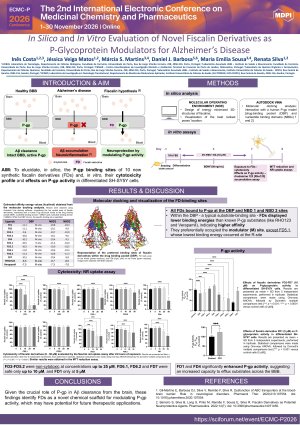
Alzheimer’s disease (AD) is a neurodegenerative disorder characterized by amyloid-beta (Aβ) accumulation in the brain. Central nervous system homeostasis is maintained, in part, by the blood-brain barrier (BBB), where the luminal efflux transporter P-glycoprotein (P-gp/ABCB1) plays a key role in clearing Aβ into the systemic circulation. In AD, BBB impairment and the loss of P-gp function disrupt this mechanism, accelerating Aβ deposition, neuroinflammation, and cognitive decline [1]. Fiscalins are valine-derived alkaloids bearing an indolyl moiety and a tricyclic anthranilic acid scaffold, previously reported to modulate P-gp activity and exert neuroprotective effects [2]. This work thus aimed to elucidate, in silico, the P-gp binding sites of 10 new synthetic fiscalin derivatives (FDs), using Molecular Operating Environment (MOE) and AutoDock Vina software, and to evaluate, in vitro, their cytotoxicity (0-50 µM; neutral red uptake and MTT reduction assays; 24 h exposure) and their effects on P-gp activity (rhodamine 123 [Rho123] accumulation assay) in differentiated SH-SY5Y cells. Docking analysis revealed that all FDs bound to P-gp at three binding sites: the drug-binding pocket (DBP) and nucleotide-binding domains (NBDs) 1 and 2. Within the DBP - a typical substrate-binding site - FDs displayed lower (more negative) binding energies than known P-gp substrates, indicating higher affinity. They preferentially occupied the modulator (M) site, except FD5.1, whose lowest binding energy occurred at the Rho123 site. In vitro, FD2-FD6.1 were non-cytotoxic at concentrations up to 25 µM, FD6.2 and FD7 were safe up to 10 µM, and FD1 only at 5 µM. Notably, FD1 and FD4 significantly enhanced P-gp activity, suggesting an increased capacity to efflux substrates across the BBB. Given the role of P-gp in Aβ clearance, these findings identify FDs as a novel chemical scaffold for restoring BBB efflux function, opening a promising avenue for disease-modifying strategies in AD.
Keywords
Alzheimer's disease
P-glycoprotein
Blood-brain barrier
Fiscalin derivatives
Poster
Poster ECMC-P.pdf
Molecular Docking Investigation of Eg5 Enzyme Inhibition by Hydroxyquinolone Derivatives
Design, synthesis, and biological evaluation of imidazophenanthrolines as human topoisomerase I inhibitors