Event submissions
EventsThe 2nd International Electronic Conference on Medicinal Chemistry and Pharmaceutics
Published
This submission belongs to the session S3. New Small Molecules as Drug Candidates of the event The 2nd International Electronic Conference on Medicinal Chemistry and Pharmaceutics
Published date
28 Oct, 2026
Academic Editor
 Mary J. Meegan
Contribution&Funding
Conceptualization,
[Jean Guillon]
Methodology,
[Jean Guillon] ; [LARI Lindita]
Validation,
[Jean Guillon]
Formal analysis,
[LARI Lindita]
Investigation,
[Jean Guillon] ; [LARI Lindita]
Writing - original draft,
[Jean Guillon]
Writing - review,
[editing] ; [Jean Guillon]
Visualization,
[Jean Guillon] ; [LARI Lindita]
Supervision,
[Jean Guillon]
Project administration,
[Jean Guillon]
Funding acquisition,
[Jean Guillon]
Funding: --
Citation
Jean Guillon, LARI Lindita, Dual-target pyrrolo[1,2-a]quinoxaline hydrazones : bridging anti-leukemic and antimalarial drug discovery, in Proceedings of The 2nd International Electronic Conference on Medicinal Chemistry and Pharmaceutics, 1 November–30 November 2026, MDPI: Basel, Switzerland
Share
Email
Facebook
Twitter
LinkedIn
Dual-target pyrrolo[1,2-a]quinoxaline hydrazones : bridging anti-leukemic and antimalarial drug discovery

Jean Guillon 1

LARI Lindita 2
1. UFR des Sciences Pharmaceutiques - Collège Sciences de la Santé, University of Bordeaux, Bordeaux, 33000, France
2. Collège Science de la vie et de la santé, University of Bordeaux, Bordeaux, 33000, France
Abstract
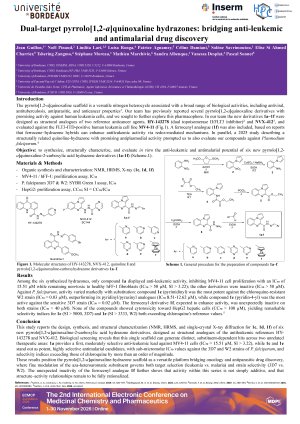
This study reports the synthesis, structural characterization and evaluation of new pyrrolo[1,2-a]quinoxaline-2-carboxylic acid hydrazone derivatives (1a–1f) as structural analogues of the antileukemic reference compounds HY-143278 and NVX-412, and synthesized from 2-nitroaniline through a six-step pathway. Structural characterization was achieved by ¹H/¹³C NMR, HRMS, and single-crystal X-ray diffraction (for 1c, 1d, and 1f), confirming the (E)-configuration of the hydrazone linkage and, for 1d, a minor ketoenol tautomeric equilibrium in solution.
These compounds were first evaluated in vitro against the human acute myeloid leukemia cell line MV4-11 (FLT3-ITD mutated). Only the pyridin-2-yl derivative 1a showed measurable antiproliferative activity (IC₅₀ = 15.51 µM), with low toxicity toward healthy hFF-1 fibroblasts (selectivity index > 3.22). Given the structural similarity between hydrazones 1and a recently reported antimalarial quinoline-hydrazone, the series was further screened for antiplasmodial activity against the chloroquine-sensitive (3D7) and chloroquine-resistant (W2) strains of Plasmodium falciparum. The pyridin-4-yl derivative 1c displayed the highest potency against 3D7 (IC₅₀ = 0.02 µM, SI > 5000), while the pyrimidinyl derivative 1e was the most active against W2 (IC₅₀ = 0.03 µM, SI > 3333) both markedly outperforming chloroquine's selectivity profile. None of the compounds showed cytotoxicity toward human HepG2 hepatic cells (CC₅₀ > 100 µM), and the ferrocenyl analogue 1f was unexpectedly inactive against both parasitic strains.
Overall, these results demonstrate that subtle structural modifications of the pyrrolo[1,2-a]quinoxaline-hydrazone scaffold drive distinct and selective biological profiles, positioning this chemical series as a versatile platform bridging anti-leukemic and antimalarial drug discovery.
Keywords
Pyrrolo[1,2-a]quinoxaline
Hydrazone derivatives
Acute myeloid leukemia
antimalarial
Plasmodium falciparum
Structure–activity relationship
Poster
ECMC 2026 - J Guillon .pdf
Novel Glycosylpyrazoles as Tumour-Associated Carbonic Anhydrase Inhibitors: Key Roles of Sulfonamide and Methoxyaryl Groups in Isoform Selectivity
Synthesis of new derivatives of 8-trifluoromethylquinobenzothiazine