Event submissions
EventsThe 2nd International Electronic Conference on Medicinal Chemistry and Pharmaceutics
Published
This submission belongs to the session S3. New Small Molecules as Drug Candidates of the event The 2nd International Electronic Conference on Medicinal Chemistry and Pharmaceutics
Published date
28 Oct, 2026
Academic Editor
 Alfredo Berzal-Herranz
Citation
Daria Klimoszek, Małgorzata Jeleń, Małgorzata Dołowy, Synthesis of new derivatives of 8-trifluoromethylquinobenzothiazine, in Proceedings of The 2nd International Electronic Conference on Medicinal Chemistry and Pharmaceutics, 1 November–30 November 2026, MDPI: Basel, Switzerland
Share
Email
Facebook
Twitter
LinkedIn
Synthesis of new derivatives of 8-trifluoromethylquinobenzothiazine

Daria Klimoszek 1
Małgorzata Jeleń 2

Małgorzata Dołowy 3
1. Faculty of Pharmaceutical Sciences in Sosnowiec, Doctoral School, Medical University of Silesia in Katowice, Katowice, 40-055, Poland
2. Department of Organic Chemistry, Faculty of Pharmaceutical Sciences in Sosnowiec, Medical University of Silesia in Katowice, Sosnowiec, 41-200, Poland
3. Department of Analytical Chemistry, Faculty of Pharmaceutical Sciences in Sosnowiec, Medical University of Silesia in Katowice, Sosnowiec, 41-200, Poland, Poland
Abstract
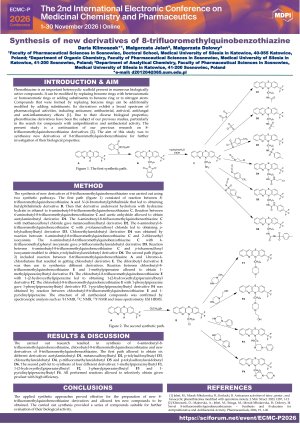
Phenothiazine is an important heterocyclic scaffold present in numerous biologically active compounds. Its derivatives exhibit a broad spectrum of pharmacological activities, including anticancer, antibacterial, antiviral, antifungal and anti-inflammatory effects. Due to their diverse biological properties, phenothiazine derivatives have been the subject of our previous studies, particularly in the search for compounds with antiproliferative and antibacterial activity. The present study is a continuation of our previous research on 8-trifluoromethylquinobenzothiazine derivatives. The aim of this study was to synthesize new derivatives of 8-trifluoromethylquinobenzothiazine for further investigation of their biological properties. The synthesis was carried out using two synthetic pathways. The first path consisted of reaction between 8-trifluoromethylquinobenzothiazine and N-(4-bromobutyl)phthalimide that led to obtaining butylphthalimide derivative. Then that derivative underwent hydrolysis with hydrazine hydrate in ethanol to 6-aminobutyl-8-trifluoromethylquinobenzothiazine. The 6-aminobutyl-8-trifluoromethylquinobenzothiazine was use to synthesize six different derivatives: acetylaminobutyl, metanosulfonylbutyl, p-tolylsulfonylbutyl, chloroethylureidobutyl, p-trifluoromethylureidobutyl and p-tolylsulfonylureidobutyl. The second path included reaction between 8-trifluoromethylquinobenzothiazine and 1-bromo-4-chlorobutane that resulted in getting chlorobutyl derivative. The chlorobutyl derivative was then use to synthesize four different derivatives: 1-methylpiperazinylbutyl, 1-(2-hydroxyethyl)piperazinylbutyl, 1-phenylpiperazinylbutyl and 1-pyridinylpiperazinylbutyl. The structure of all synthesized compounds was confirmed by spectroscopic analysis such as 1H NMR, 13C NMR, 19F NMR and mass spectrometry ESI HRMS. The applied synthetic approaches proved effective for the preparation of new 8-trifluoromethylquinobenzothiazine derivatives and provided a series of compounds suitable for further evaluation of their biological activity.
Keywords
phenothiazine
quinobenzothiazine
Poster
Synthesis of new derivatives of 8-trifluoromethylquinobenzothiazine - D. Klimoszek and the others.pdf
Dual-target pyrrolo[1,2-a]quinoxaline hydrazones : bridging anti-leukemic and antimalarial drug discovery
Molecular Docking Studies of Natural Compounds Targeting Diabesity in Polycystic Ovary Syndrome via the AMPK Pathway