Event submissions
EventsThe 2nd International Electronic Conference on Medicinal Chemistry and Pharmaceutics
Published
This submission belongs to the session S3. New Small Molecules as Drug Candidates of the event The 2nd International Electronic Conference on Medicinal Chemistry and Pharmaceutics
Published date
28 Oct, 2026
Academic Editor
 Maria Emília Sousa
Citation
Nikola Nedeljković, Vladimir Dobričić, Emilija Stefanović, Marina Vesović, Miloš Nikolić, Molecular Docking Analysis of Selected Thiourea Derivatives of Naproxen with Human Serum Albumin, in Proceedings of The 2nd International Electronic Conference on Medicinal Chemistry and Pharmaceutics, 1 November–30 November 2026, MDPI: Basel, Switzerland
Share
Email
Facebook
Twitter
LinkedIn
Molecular Docking Analysis of Selected Thiourea Derivatives of Naproxen with Human Serum Albumin

Nikola Nedeljković 1

Vladimir Dobričić 2

Emilija Stefanović 1
Marina Vesović 1

Miloš Nikolić 1
1. Department of Pharmacy, Faculty of Medical Sciences, University of Kragujevac, Kragujevac, 34000, Serbia
2. Department of Pharmaceutical Chemistry, Faculty of Pharmacy, University of Belgrade, Belgrade, 11221, Serbia
Abstract
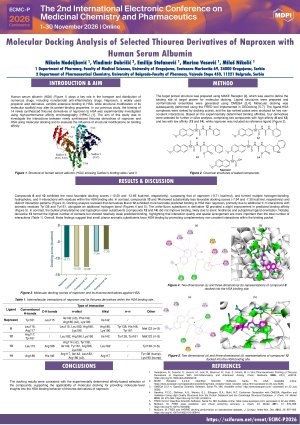
Human serum albumin (HSA) plays a key role in the transport and distribution of numerous drugs, including nonsteroidal anti-inflammatory agents. Naproxen, a widely used propionic acid derivative, exhibits extensive binding to HSA, while structural modification of its molecular scaffold may alter its protein-binding properties. In our previous study, the binding of 14 newly synthesized thiourea derivatives of naproxen to HSA was experimentally investigated using high-performance affinity chromatography (HPAC). Based on the experimentally determined binding affinities, four derivatives were selected for further in silico analysis, comprising two compounds with high affinity (8 and 12) and two with low affinity (13 and 14), while naproxen was included as a reference ligand. The target enzyme and ligand conformations were prepared using MAKE Receptor and OMEGA, respectively, followed by molecular docking with the FRED tool of OEDocking. The resulting ligand-HSA complexes were evaluated based on docking scores and non-covalent interactions. Compounds 8 and 12 exhibited the most favorable docking scores (-12.50 and -12.66 kcal/mol, respectively), surpassing that of naproxen (-9.71 kcal/mol), and formed multiple hydrogen-bonding, hydrophobic, and π-interactions with residues within the HSA binding site. In contrast, compounds 13 and 14 showed substantially less favorable docking scores (-7.94 and -7.30 kcal/mol, respectively) and distinct interaction patterns. Overall, the docking results were consistent with the experimentally determined affinity-based selection of the compounds, supporting the applicability of molecular docking for providing molecular-level insights into the HSA-binding behavior of thiourea derivatives of naproxen.
Keywords
HSA
naproxen
thiourea derivatives
molecular docking
OpenEye Scientific Software package
Poster
Nedeljkovic N - poster.pdf
SYNTHESIS AND IN VITRO/IN SILICO ANTITUMOR EVALUATION OF 4-SULFANYLQUINOLINYL AMIDE DERIVATIVES
QSAR Analysis of Substituted Cinnamic Acid Derivatives with Antibacterial Activity