Event submissions
EventsThe 2nd International Electronic Conference on Medicinal Chemistry and Pharmaceutics
Published
This submission belongs to the session S3. New Small Molecules as Drug Candidates of the event The 2nd International Electronic Conference on Medicinal Chemistry and Pharmaceutics
Published date
28 Oct, 2026
Academic Editor
 Maria Emília Sousa
Citation
Michał Janiak , Filip Jakszta, Mateusz Jędrzejewski, Marcin Gackowski, QSAR Analysis of Substituted Cinnamic Acid Derivatives with Antibacterial Activity, in Proceedings of The 2nd International Electronic Conference on Medicinal Chemistry and Pharmaceutics, 1 November–30 November 2026, MDPI: Basel, Switzerland
Share
Email
Facebook
Twitter
LinkedIn
QSAR Analysis of Substituted Cinnamic Acid Derivatives with Antibacterial Activity

Michał Janiak 1,2
Filip Jakszta 3
Mateusz Jędrzejewski 4,5

Marcin Gackowski 3
1. Doctoral School of Medical and Health Sciences, Ludwik Rydygier Collegium Medicum, Nicolaus Copernicus University in Toruń, Bydgoszcz, 85-067, Poland
2. Department of Toxicology and Bromatology, Ludwik Rydygier Collegium Medicum in Bydgoszcz, Nicolaus Copernicus University in Torun, Bydgoszcz, 85-089, Poland
3. Department of Toxicology and Bromatology, Ludwik Rydygier Collegium Medicum in Bydgoszcz, Nicolaus Copernicus University in Torun, Bydgoszcz, 85-089, Poland
4. Department of Organic and Physical Chemistry, Medical University of Warsaw, Warsaw, 02-093, Poland
5. Doctoral School, Medical University of Warsaw, Warsaw, 02-091, Poland
Abstract
Background: Antimicrobial resistance continues to demand efficient discovery strategies. Phenylpropanoid scaffolds, such as cinnamic acid derivatives, exhibit a broad spectrum of antimicrobial potential.
Aim: to construct and validate a QSAR model for substituted cinnamic acid derivatives and to identify molecular descriptors associated with their antibacterial activity.
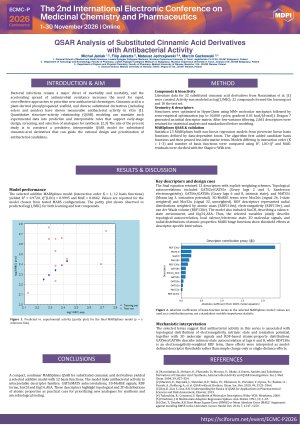
Methods: Chemical structures and antibacterial activities for 32 literature-derived cinnamic-acid derivatives were compiled; activity was expressed as log(1/MIC). The dataset comprised 22 learning and 10 test compounds. Three-dimensional structures were optimized in HyperChem using MM+ molecular mechanics followed by semi-empirical optimization. A total of 4,885 molecular descriptors were calculated using Dragon 7. Prior to modeling, descriptor data were standardized and low-variance variables were removed. Non-linear QSAR models were constructed in Statistica 13 using Multivariate Adaptive Regression Splines (MARSplines), which represent predictor effects by piecewise basis functions separated by data-dependent knots. Model construction involved generation of basis functions followed by pruning of less informative terms. Models with different interaction orders and numbers of basis functions were compared using R², leave-one-out Q², and mean absolute error (MAE); residual normality was assessed using the Shapiro–Wilk test.
Results: The selected additive MARSplines model (interaction order 1; 12 basis functions) yielded R² = 0.9720, Q²(LOO) = 0.9995, and MAE = 0.0662. The model included 12 descriptors representing complementary structural properties: Geary autocorrelations GATS2e and GATS5e weighted by Sanderson electronegativity; GATS6s and GATS8s weighted by intrinsic state; Moran autocorrelation MATS3i weighted by ionization potential; 3D-MoRSE descriptors Mor26s and Mor32u; radial distribution functions RDF110m, RDF130e, and RDF130v weighted by atomic mass, electronegativity, and van der Waals volume, respectively; the valence-state descriptor SssCH; and Eig14_AEA. The MARS equation revealed descriptor-specific threshold effects, with predictor contributions changing after the corresponding knot values were exceeded.
Conclusions: The MARSplines QSAR model identified non-linear associations between antibacterial activity and molecular features describing topological autocorrelation, intrinsic state, ionization potential, three-dimensional molecular information, and radial distributions of atomic properties. These results provide an interpretable description of structural features associated with antibacterial activity within the investigated series of cinnamic-acid derivatives.
Keywords
quantitative structure–activity relationship (QSAR); multivariate adaptive regression splines (MARSplines); cinnamic acid derivatives; antibacterial activity; Dragon molecular descriptors; non-linear modeling
Poster
ECMC-P_2026_QSAR_Cinnamic_Acid_Poster_FINAL_ostateczny.pdf
Molecular Docking Analysis of Selected Thiourea Derivatives of Naproxen with Human Serum Albumin
A multi-action Pt(IV) prodrug against aggressive cancer cells