Event submissions
EventsThe 2nd International Electronic Conference on Medicinal Chemistry and Pharmaceutics
Published
This submission belongs to the session S3. New Small Molecules as Drug Candidates of the event The 2nd International Electronic Conference on Medicinal Chemistry and Pharmaceutics
Published date
28 Oct, 2026
Academic Editor
 Mary J. Meegan
Citation
Luis Diaz, Rafael Rodriguez, Gabriela Fernández Pérez, Design of Potential Antimalarial Molecules Using QSAR, Molecular Docking and Molecular Dynamics Techniques, in Proceedings of The 2nd International Electronic Conference on Medicinal Chemistry and Pharmaceutics, 1 November–30 November 2026, MDPI: Basel, Switzerland
Share
Email
Facebook
Twitter
LinkedIn
Design of Potential Antimalarial Molecules Using QSAR, Molecular Docking and Molecular Dynamics Techniques

Luis Diaz 1
Rafael Rodriguez 2
Gabriela Fernández Pérez 3
1. Chemical and Biomolecular Synthesis Laboratory, Department of Phisical Chemistry, Faculty of Chemistry, University of Havana, Havana, 10400, Cuba
2. Department of Phisical Chemistry, Faculty of Chemistry, University of Havana, Havana, 10400, Cuba
3. Laboratory of chemical and biochemical synthesis (SINTLAB), Faculty of Chemistry, University of Havana, Havana, 10400, Cuba
Abstract
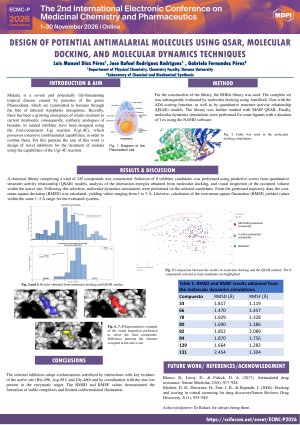
Malaria is a serious and potentially fatal tropical disease caused by parasites of the genus Plasmodium, transmitted to humans by the bite of infected Anopheles mosquitoes. There has recently been a growing emergence of strains resistant to current treatments, and synthetic analogues of bestatin, its natural inhibitor, have been designed using the four-component Ugi reaction (Ugi-4C), which has great combinatorial capabilities, to combat them. The objective is to design new inhibitors for malaria treatment using the capabilities of the Ugi-4C reaction. For library construction, the RDKit library was used. The complete set was evaluated by molecular docking (with AutoDock Vina, using the AD4 scoring function) and quantitative structure–activity relationship (QSAR) models. The library was studied with MAIP QSAR. Molecular dynamics simulations of some ligands of 1 ns duration were performed using NAMD software. A library of 245 compounds was built. Taking into account the energies obtained from molecular docking and the QSAR score, 8 inhibitor candidates were selected. From the molecular dynamics simulations performed on the 8 candidates, a root-mean-square deviation (RMSD) between 1–3 Å and a root-mean-square fluctuation (RMSF) in the ranges of 1–3 Å were obtained. The selected inhibitors adopt conformations stabilized by interactions with key residues of the active site (His-496, Asp-581, and Gly-460) and by coordination with the zinc ion present in the enzyme target. The RMSD and RMSF values evidenced the formation of stable complexes and limited conformational fluctuation.
Keywords
malaria; molecular docking; molecular dynamics simulations.
Poster
poster_sciforum_Luis_Manuel.pdf
A multi-action Pt(IV) prodrug against aggressive cancer cells
Peptide Engineering Strategies for AT1R: Structure-Based Analysis of Angiotensin II Analogues