Event submissions
EventsThe 2nd International Electronic Conference on Medicinal Chemistry and Pharmaceutics
Published
This submission belongs to the session S3. New Small Molecules as Drug Candidates of the event The 2nd International Electronic Conference on Medicinal Chemistry and Pharmaceutics
Published date
28 Oct, 2026
Academic Editor
 Mary J. Meegan
Citation
Sepideh Jafari, Joanna Bojarska, Peptide Engineering Strategies for AT1R: Structure-Based Analysis of Angiotensin II Analogues, in Proceedings of The 2nd International Electronic Conference on Medicinal Chemistry and Pharmaceutics, 1 November–30 November 2026, MDPI: Basel, Switzerland
Share
Email
Facebook
Twitter
LinkedIn
Peptide Engineering Strategies for AT1R: Structure-Based Analysis of Angiotensin II Analogues

Sepideh Jafari 1
Joanna Bojarska 1
1. Institute of General and Ecological Chemistry, Faculty of Chemistry, University of Technology, Lodz, 90-924, Poland
Abstract
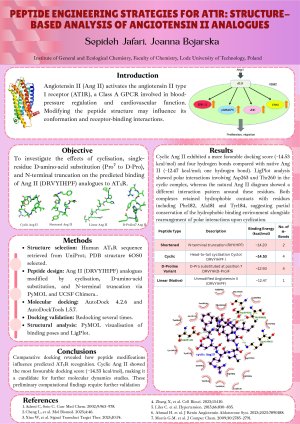
The angiotensin II type 1 receptor (AT1R) is a Class A G protein-coupled receptor activated by the endogenous octapeptide angiotensin II (Ang II) and plays a central role in blood-pressure regulation, fluid homeostasis and cardiovascular signalling. The well-characterised peptide–receptor system provides a useful model for investigating how defined peptide modifications influence GPCR recognition.
In this study, Ang II was used as a reference scaffold for the structure-based design of peptide analogues with altered conformational and physicochemical properties. The investigated strategies included head-to-tail cyclisation, introduction of D-amino-acid residues and N-terminal truncation. Molecular docking with AT1R was used to compare the resulting binding poses, receptor-contact patterns and the preservation or redistribution of key peptide–receptor interactions.
The head-to-tail cyclic analogue showed the most favourable docking performance compared with native Ang II. It retained favourable AT1R interactions while displaying a modified hydrogen-bond and hydrophobic contact pattern, suggesting that cyclisation can influence peptide–receptor recognition
The comparative analysis is intended to identify which peptide-engineering strategies preserve favourable AT1R recognition while modifying peptide conformation. These results may provide a basis for further molecular dynamics studies and for the rational design of conformationally controlled peptide ligands targeting AT1R.
References:
1. Adessi C., Soto C. Curr Med Chem. 2002;9:963–978.
2. Cheng L. et al. Mol Biomed. 2023;4:46.
3. Xiao W. et al. Signal Transduct Target Ther. 2025;10:74.
4. Zhang X. et al. Cell Biosci. 2023;13:110.
5. Liles C. et al. Hypertension. 2015;66:830–835.
6. Ahmad H. et al. J Renin Angiotensin Aldosterone Syst. 2023;2023:7890188.
7. Morris G.M. et al. J Comput Chem. 2009;30:2785–2791.
Keywords
Angiotensin II; AT1R; GPCR; peptide engineering; peptide analogues; molecular docking; structure-based drug design
Poster
poster-conference.pdf
Design of Potential Antimalarial Molecules Using QSAR, Molecular Docking and Molecular Dynamics Techniques
Novel Sila-Vitamin D Derivatives Targeting the Vitamin D Receptor for Application in Cancer Therapy