Event submissions
EventsThe 2nd International Electronic Conference on Medicinal Chemistry and Pharmaceutics
Published
This submission belongs to the session S3. New Small Molecules as Drug Candidates of the event The 2nd International Electronic Conference on Medicinal Chemistry and Pharmaceutics
Published date
28 Oct, 2026
Academic Editor
 Alfredo Berzal-Herranz
Contribution&Funding
Funding: Acknowledgements: This work received financial support from FEDER (COMPETE 2030), under the framework of the project with reference COMPETE2030-FEDER-00881500 and operation no. 15152, and from the Fundação para a Ciência e Tecnologia and Ministério da Edu
Citation
Maria B. Igreja-Cardoso, José E. Rodríguez-Borges, Ivo E. Sampaio-Dias, Novel Sila-Vitamin D Derivatives Targeting the Vitamin D Receptor for Application in Cancer Therapy, in Proceedings of The 2nd International Electronic Conference on Medicinal Chemistry and Pharmaceutics, 1 November–30 November 2026, MDPI: Basel, Switzerland
Share
Email
Facebook
Twitter
LinkedIn
Novel Sila-Vitamin D Derivatives Targeting the Vitamin D Receptor for Application in Cancer Therapy

Maria B. Igreja-Cardoso 1
José E. Rodríguez-Borges 1
Ivo E. Sampaio-Dias 1
1. LAQV/REQUIMTE, Department of Chemistry and Biochemistry, Faculty of Sciences, University of Porto, Porto, Portugal
Abstract
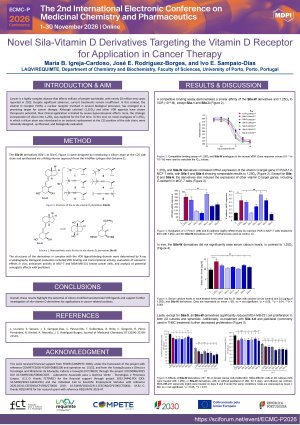
Cancer is a highly complex disease that affects millions of people worldwide, with nearly 20 million new cases reported in 2022. Despite significant advances, current treatments remain insufficient. In this context, the vitamin D receptor (VDR), a nuclear receptor involved in several biological processes, has emerged as a promising target for cancer therapy. Although calcitriol (1,25D3) and other VDR agonists have shown therapeutic potential, their clinical application is limited by severe hypercalcaemic effects.
Here, the strategic incorporation of silicon into 1,25D3 was explored for the first time. To this end, six novel analogues of 1,25D3, in which a silicon atom was introduced as an isosteric replacement at the C25 position of the side chain, were rationally designed, synthesised, and biologically evaluated.
The designed sila-derivatives were successfully synthesised via a Wittig-Horner approach from the Inhoffen-Lythgoe diol. Structural studies of VDR complexes with the sila-derivatives revealed favourable interactions between the modified side chains and the VDR ligand-binding domain. Functional assays demonstrated that the analogues retained VDR-mediated activity while exhibiting markedly lower hypercalcaemic effects than 1,25D3. Their biological effects were further investigated in cancer cell lines (HaCaT, SKOV-3, PC-3, MCF-7, and MDA-MB-231 cells), where, in combination with conventional chemotherapeutics, the analogues significantly reduced cancer cell proliferation, suggesting potential synergistic effects.
Overall, these results highlight the potential of silicon-modified secosteroidal VDR ligands and support further investigation of sila-vitamin D derivatives for applications in cancer-related contexts.
Keywords
Breast Cancer Therapy
Silicon
Vitamin D
Vitamin D Receptor
Poster
ECMC-P2026_Maria.pdf
Peptide Engineering Strategies for AT1R: Structure-Based Analysis of Angiotensin II Analogues
Modulating effect of low-molecular allosteric regulators of the thyroid-stimulating hormonereceptor on thyroid function in rats exposed to low temperatures