Event submissions
EventsThe 2nd International Electronic Conference on Medicinal Chemistry and Pharmaceutics
Published
This submission belongs to the session S3. New Small Molecules as Drug Candidates of the event The 2nd International Electronic Conference on Medicinal Chemistry and Pharmaceutics
Published date
28 Oct, 2026
Academic Editor
 Mary J. Meegan
Contribution&Funding
Methodology,
[ayriana safari baesmat]
Software,
[ayriana safari baesmat]
Formal analysis,
[ayriana safari baesmat]
Investigation,
[ayriana safari baesmat]
Writing - original draft,
[ayriana safari baesmat]
Visualization,
[ayriana safari baesmat]
Funding: --
Citation
ayriana safari baesmat, E2F-Driven Proliferative Transcription Characterizes an MK-2206-Sensitive AML State and Is Suppressed Following AKT Inhibition, in Proceedings of The 2nd International Electronic Conference on Medicinal Chemistry and Pharmaceutics, 1 November–30 November 2026, MDPI: Basel, Switzerland
Share
Email
Facebook
Twitter
LinkedIn
E2F-Driven Proliferative Transcription Characterizes an MK-2206-Sensitive AML State and Is Suppressed Following AKT Inhibition

ayriana safari baesmat 1
1. Faculty of Medicine, Lokman Hekim University, Ankara, 06700, Turkey (Türkiye)
Abstract
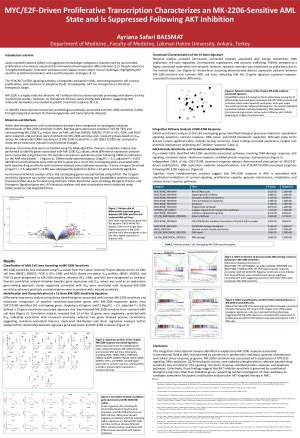
Background: Acute myeloid leukemia (AML) is a heterogeneous hematologic malignancy in which dysregulated survival, proliferation, and metabolic signaling contribute to treatment resistance. The PI3K/AKT/mTOR pathway is frequently implicated in leukemic cell survival, making AKT inhibition a potential therapeutic strategy. This study aimed to identify transcriptomic features associated with sensitivity to MK-2206, a selective allosteric AKT inhibitor, in AML.
Methods: Publicly available pharmacogenomic and transcriptomic datasets were integrated to characterize molecular features associated with MK-2206 response. Baseline gene-expression profiles from six AML cell lines were analyzed with MK-2206 IC50 values and classified as sensitive or resistant using a three-versus-three comparison. Differential expression analysis was performed between sensitive and resistant cell lines, while GSE172189 was used to assess transcriptional changes following MK-2206 exposure. Baseline and treatment-associated differentially expressed genes were integrated to identify overlapping MK-2206-associated genes. A stricter fold-change threshold defined a 15-gene sensitivity-associated subset. Functional enrichment, gene set enrichment analysis, and network analysis were subsequently performed.
Results: Integration identified 162 overlapping MK-2206-associated genes, from which a stricter threshold defined a 15-gene subset that distinguished sensitive from resistant AML cell lines. Network analysis revealed functional associations with energy metabolism, DNA replication, cell-cycle regulation, chromosomal organization, and vesicular trafficking, with YWHAE emerging as a highly connected node. Functional annotation of the broader gene set implicated Rho GTPase signaling, apoptosis, interferon response, DNA repair, and cell-cycle checkpoint regulation. Gene set enrichment analysis demonstrated suppression of MYC/E2F-associated proliferation, DNA replication, DNA repair, G2/M checkpoint, mitotic spindle, and oxidative phosphorylation programs following MK-2206 exposure, alongside activation of stress-response pathways including unfolded protein response and p53-associated DNA-damage signaling.
Conclusion: MK-2206 sensitivity in AML appears to reflect a broader transcriptional state involving proliferative, metabolic, genome-maintenance, apoptotic, interferon-related, and cellular stress-response programs rather than dependence on a single gene.
Keywords
acute myeloid leukemia
AKT inhibitor
MK-2206 sensitivity
pharmacogenomics
transcriptomic signature
gene set enrichment analysis
Poster
MK2206 and AML.pdf
Modulating effect of low-molecular allosteric regulators of the thyroid-stimulating hormonereceptor on thyroid function in rats exposed to low temperatures
Evaluation of the antinociceptive and anti-inflammatory activity of 2-morpholinoethyl 2-(naphthalen-2-yloxy)acetate and 2-(piperidin-1-yl)ethyl 2-(naphthalen-2-yloxy)acetate as novel Sigma-1 receptor antagonists