Event submissions
EventsThe 2nd International Electronic Conference on Medicinal Chemistry and Pharmaceutics
Published
This submission belongs to the session S3. New Small Molecules as Drug Candidates of the event The 2nd International Electronic Conference on Medicinal Chemistry and Pharmaceutics
Published date
28 Oct, 2026
Academic Editor
 Mary J. Meegan
Contribution&Funding
Conceptualization,
[Miguel Angel Zavala Sanchez] ; [Cuauhtemoc Perez González]
Methodology,
[Juan José Guerrero-Macedonio] ; [Cuauhtemoc Perez González]
Validation,
[Estanislao Jimenez-Perez]
Formal analysis,
[Miguel Angel Zavala Sanchez]
Investigation,
[Juan José Guerrero-Macedonio]
Writing - review,
[editing] ; [Miguel Angel Zavala Sanchez]
Visualization,
[Estanislao Jimenez-Perez]
Supervision,
[Miguel Angel Zavala Sanchez] ; [Cuauhtemoc Perez González] ; [Estanislao Jimenez-Perez]
Funding: SECIHTI GRANT TO GUERRERO MACEDONIO JJ.
Citation
Juan José Guerrero-Macedonio, Miguel Angel Zavala Sanchez, Cuauhtemoc Perez González, Estanislao Jimenez-Perez, Evaluation of the antinociceptive and anti-inflammatory activity of 2-morpholinoethyl 2-(naphthalen-2-yloxy)acetate and 2-(piperidin-1-yl)ethyl 2-(naphthalen-2-yloxy)acetate as novel Sigma-1 receptor antagonists, in Proceedings of The 2nd International Electronic Conference on Medicinal Chemistry and Pharmaceutics, 1 November–30 November 2026, MDPI: Basel, Switzerland
Share
Email
Facebook
Twitter
LinkedIn
Evaluation of the antinociceptive and anti-inflammatory activity of 2-morpholinoethyl 2-(naphthalen-2-yloxy)acetate and 2-(piperidin-1-yl)ethyl 2-(naphthalen-2-yloxy)acetate as novel Sigma-1 receptor antagonists

Juan José Guerrero-Macedonio 1
Miguel Angel Zavala Sanchez 1
Cuauhtemoc Perez González 1
Estanislao Jimenez-Perez 1
1. Department of Biological Systems, Universidad Autónoma Metropolitana Unidad Xochimilco, Mexico City 04960, Mexico
Abstract
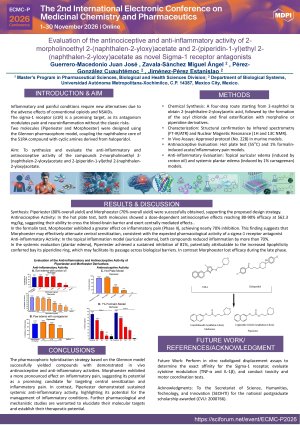
The sigma-1 receptor represents a highly promising therapeutic alternative to classical opioids and NSAIDs for the management of pain and inflammation. The development of highly selective compounds with optimal pharmacokinetic profiles remains a critical challenge in medicinal chemistry. In this study, novel ligands were designed through a pharmacophoric hybridization strategy based on the Glennon model, coupling the naphthalene nucleus of S1RA with haloperidol-derived cyclic amines via an ester linker. Following computational validation through molecular docking at the sigma-1 receptor, two main molecules were chemically synthesized: Piperiéster (piperidine derivative) and Morfoéster (morpholine derivative). Their biological efficacy was subsequently evaluated in vivo using murine models of pain (hot plate and formalin tests) and inflammation (croton oil-induced auricular edema and carrageenan-induced plantar edema). It was observed that both molecules showed a clear dose-dependent antinociceptive effect in the hot plate test, reaching 80-90% efficacy, indicating their ability to cross the blood-brain barrier. In the formalin model, Morfoéster proved superior for inflammatory pain, achieving nearly 70% inhibition in Phase II, characteristic of central sensitization blockade. Conversely, in systemic inflammation evaluations (plantar edema), Piperiéster exhibited a remarkable 81% inhibition. Both compounds also successfully reduced topical inflammation by more than 70% in the auricular edema model. These results allow us to conclude that the hybridization strategy successfully yielded novel sigma-1 receptor ligands with proven biological activity. Morfoéster emerges as an optimal clinical tool for central and inflammatory pain, while Piperiéster demonstrates a notable capacity to curb systemic inflammation. Both derivatives represent excellent starting points for the development of safer new therapies without the side effects of conventional treatments.
Keywords
sigma-1; antagonists; chemical synthesis; pharmacophoric hybridization; pain modulation; anti-inflammatory agents; in vivo models
Poster
Posters JJGM.pdf
E2F-Driven Proliferative Transcription Characterizes an MK-2206-Sensitive AML State and Is Suppressed Following AKT Inhibition
Mutagenicity assessment of novel nitroimidazooxazole anti-infective candidates using the Ames Test