Event submissions
EventsThe 2nd International Electronic Conference on Medicinal Chemistry and Pharmaceutics
Published
This submission belongs to the session S3. New Small Molecules as Drug Candidates of the event The 2nd International Electronic Conference on Medicinal Chemistry and Pharmaceutics
Published date
28 Oct, 2026
Academic Editor
 Mary J. Meegan
Contribution&Funding
Conceptualization,
[Jean Leandro Dos Santos] ; [Manoela de Araújo Gonçalves] ; [Isabelle Guerreiro Moreira] ; [Cauê Benito Scarim] ; [Nicole Pichirilli Catirce] ; [João Lucas Bruno Leandro dos Santos] ; [Flavia Aparecida Resende]
Methodology,
[Flavia Aparecida Resende] ; [Cauê Benito Scarim] ; [João Lucas Bruno Leandro dos Santos] ; [Nicole Pichirilli Catirce] ; [Manoela de Araújo Gonçalves]
Formal analysis,
[Nicole Pichirilli Catirce] ; [Jean Leandro Dos Santos]
Investigation,
[Nicole Pichirilli Catirce] ; [Flavia Aparecida Resende] ; [Isabelle Guerreiro Moreira] ; [Manoela de Araújo Gonçalves] ; [Jean Leandro Dos Santos]
Data curation,
[Cauê Benito Scarim] ; [Jean Leandro Dos Santos] ; [Flavia Aparecida Resende] ; [Nicole Pichirilli Catirce]
Writing - original draft,
[Jean Leandro Dos Santos]
Writing - review,
[editing] ; [Cauê Benito Scarim] ; [Jean Leandro Dos Santos] ; [Isabelle Guerreiro Moreira] ; [Flavia Aparecida Resende]
Visualization,
[Cauê Benito Scarim] ; [João Lucas Bruno Leandro dos Santos] ; [Jean Leandro Dos Santos] ; [Nicole Pichirilli Catirce] ; [Isabelle Guerreiro Moreira] ; [Flavia Aparecida Resende]
Supervision,
[Flavia Aparecida Resende]
Project administration,
[Jean Leandro Dos Santos]
Funding acquisition,
[Jean Leandro Dos Santos]
Funding: The authors acknowledge financial support from FAPESP (grants 2025/23900-4, 2025/06606-5, 2023/07154-5, 2023/02103-3, 2020/13279-7, 2020/13497-4, 2018/00187-7, and 2013/07600-3), FINEP (3348/2022-CCP), CAPES (Finance Code 001), CNPq (401319/2025-3 and 302
Citation
Manoela de Araújo Gonçalves, Isabelle Guerreiro Moreira, Nicole Pichirilli Catirce, João Lucas Bruno Leandro dos Santos, Cauê Benito Scarim, Jean Leandro Dos Santos, Flavia Aparecida Resende, Mutagenicity assessment of novel nitroimidazooxazole anti-infective candidates using the Ames Test, in Proceedings of The 2nd International Electronic Conference on Medicinal Chemistry and Pharmaceutics, 1 November–30 November 2026, MDPI: Basel, Switzerland
Share
Email
Facebook
Twitter
LinkedIn
Mutagenicity assessment of novel nitroimidazooxazole anti-infective candidates using the Ames Test

Manoela de Araújo Gonçalves 1
Isabelle Guerreiro Moreira 1
Nicole Pichirilli Catirce 1
João Lucas Bruno Leandro dos Santos 2
Cauê Benito Scarim 3

Jean Leandro Dos Santos 3
Flavia Aparecida Resende 1
1. Laboratory of Mutagenesis, University of Araraquara (UNIARA), Araraquara, Brazil
2. School of Pharmaceutical Sciences, São Paulo State University (UNESP), Araraquara, Brazil
3. Drugs and Medicine, School of Pharmaceutical Sciences, São Paulo State University (UNESP), Araraquara, Brazil
Abstract
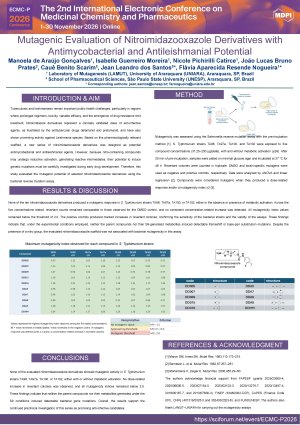
Nitroimidazole-based compounds are widely explored as anti-infective agents, although their nitro group may be associated with genotoxicity concerns. Here, we investigated the mutagenic profile of ten nitroimidazooxazole derivatives (49–58) previously developed for antimycobacterial and antileishmanial applications. The compounds were evaluated by the Ames test using Salmonella Typhimurium strains TA98, TA97a, TA100, and TA102, with and without metabolic activation by S9. Five concentrations were tested, from 31.25 to 250 μg/plate, using the pre-incubation protocol, with assays performed in triplicate. Mutagenicity was evaluated using revertant colony counts, dose-response trends, statistical comparisons with the negative control, and the mutagenicity index. Across all strains and experimental conditions, none of the compounds produced a significant increase in the number of revertants. The mutagenicity index remained below 2 at every concentration tested, and no consistent concentration-dependent response was observed. The expected responses obtained with the positive controls confirmed the validity of the assays. Taken together, these results show that derivatives 49–58 did not exhibit mutagenic activity in the bacterial reverse mutation assay, regardless of metabolic activation, supporting their continued preclinical evaluation as anti-infective candidates.
Keywords
Nitroimidazooxazoles; Mutagenicity; Genotoxicity; Metabolic activation; Anti-infective agentes.
Poster
Mutagenic evaluation of nitroimidazo derivatives.pdf
Evaluation of the antinociceptive and anti-inflammatory activity of 2-morpholinoethyl 2-(naphthalen-2-yloxy)acetate and 2-(piperidin-1-yl)ethyl 2-(naphthalen-2-yloxy)acetate as novel Sigma-1 receptor antagonists
In Silico Screening of the MolPort Natural Product Database to Identify Potential Lyn Tyrosine Kinase Inhibitors for the Treatment of Triple-Negative Breast Cancer