Event submissions
EventsThe 2nd International Electronic Conference on Medicinal Chemistry and Pharmaceutics
Published
This submission belongs to the session S3. New Small Molecules as Drug Candidates of the event The 2nd International Electronic Conference on Medicinal Chemistry and Pharmaceutics
Published date
28 Oct, 2026
Academic Editor
 Maria Emília Sousa
Contribution&Funding
Conceptualization,
[Jovana Ajdukovic]
Software,
[Djordje Jankovic]
Validation,
[Sébastien Pomel]
Investigation,
[Marina Savic] ; [Lukas Montejo]
Data curation,
[Djordje Jankovic] ; [Marina Savic]
Writing - original draft,
[Jovana Ajdukovic]
Writing - review,
[editing] ; [Marina Savic] ; [Sébastien Pomel]
Visualization,
[Lukas Montejo]
Project administration,
[Jovana Ajdukovic] ; [Sébastien Pomel]
Funding: Presented results are obtained within the framework of the bilateral cooperation between the French Republic and the Republic of Serbia, under the „Pavle Savić programme” and „Hubert Curien Partnerships (PHC)” (Grant No. 337-00-93/2023-05/12, New steroid
Citation
Jovana Ajdukovic, Djordje Jankovic, Marina Savic, Lukas Montejo, Sébastien Pomel, Natural Product-Based Antileishmanial Drug Discovery – Preliminary in silico study, in Proceedings of The 2nd International Electronic Conference on Medicinal Chemistry and Pharmaceutics, 1 November–30 November 2026, MDPI: Basel, Switzerland
Share
Email
Facebook
Twitter
LinkedIn
Natural Product-Based Antileishmanial Drug Discovery – Preliminary in silico study

Jovana Ajdukovic 1

Djordje Jankovic 2

Marina Savic 1
Lukas Montejo 3
Sébastien Pomel 3
1. Department of Chemistry, Biochemistry and Environmental Protection, University of Novi Sad, Faculty of Sciences, Novi Sad, 21000, Serbia
2. Department of Chemistry, Biochemistry and Environmental , University of Novi Sad, Faculty of Sciences, Novi Sad, 21000, Serbia
3. CNRS BioCIS, Université Paris-Saclay, Orsay, 91400, France
Abstract
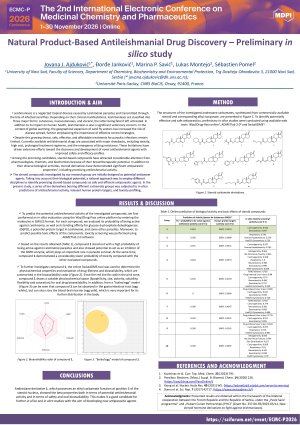
Leishmaniasis is a neglected tropical disease caused by Leishmania parasites and transmitted through the bite of infected sand flies. Depending on their clinical manifestations, leishmaniases are classified into three major forms: cutaneous, mucocutaneous, and visceral, the latter being fatal if left untreated. In addition to its impact on human health, leishmaniasis is also a significant veterinary concern, particularly in dogs infected with L. infantum, which serve as the main reservoir hosts. In the context of global warming, the geographical expansion of sand fly vectors has increased the risk of disease spread, further emphasizing the importance of effective control strategies. Despite this growing threat, safe, effective, and affordable treatments for parasitic infections remain limited. Currently available antileishmanial drugs are associated with major drawbacks, including toxicity, high cost, prolonged treatment regimens, and the emergence of drug resistance. These limitations have driven extensive efforts toward the discovery and development of novel antileishmanial agents with improved safety and efficacy profiles. Among the promising candidates, steroid-based compounds have attracted considerable attention from pharmacologists, chemists, and biochemists because of their broad therapeutic potential. In addition to their diverse biological activities, steroid derivatives have demonstrated significant antiparasitic properties, including promising antileishmanial activity.
The steroid compounds investigated by our research group are initially designed as potential anticancer agents. Taking into account their biological potential, a rational approach was to employ different disciplines to identify promising steroid-based compounds as safe and efficient antiparasitic agents. In the present study, a series of ten derivatives bearing different carbamate groups was subjected to in silico predictions of antileishmanial activity, relevant human protein targets, and toxicity profiling, using available online tools such as Way2Drug-Pass online, ADMETlab 2.0 and SwissADME. Only one compound showed the best properties both in terms of potential antileishmanial activity and in terms of safety and oral bioavailability.
Keywords
Antiparasitic drugs
Leishmania
Steroid derivatives
In silico
Poster
Poster_Ajdukovic_final.pdf
In Silico Screening of the MolPort Natural Product Database to Identify Potential Lyn Tyrosine Kinase Inhibitors for the Treatment of Triple-Negative Breast Cancer
Oligopeptide based ternary chelators of transition metal ions as complexes for managing aggregation and redox processes of Alzheimer’s disease pathogenesis