Event submissions
EventsThe 2nd International Electronic Conference on Medicinal Chemistry and Pharmaceutics
Published
This submission belongs to the session S4. Natural Products and Biopharmaceuticals of the event The 2nd International Electronic Conference on Medicinal Chemistry and Pharmaceutics
Published date
28 Oct, 2026
Academic Editor
 Maria Emília Sousa
Contribution&Funding
Conceptualization,
[Adrián Matencio] ; [José Manuel López-Nicolás]
Investigation,
[Antonio Sanchez Belmonte]
Supervision,
[Adrián Matencio] ; [José Manuel López-Nicolás]
Funding: --
Citation
Adrián Matencio, Antonio Sanchez Belmonte, José Manuel López-Nicolás, From resveratrol to trimethoxystilbene: HPLC and docking reveal enhanced inhibition of PDE1 and PDE4, in Proceedings of The 2nd International Electronic Conference on Medicinal Chemistry and Pharmaceutics, 1 November–30 November 2026, MDPI: Basel, Switzerland
Share
Email
Facebook
Twitter
LinkedIn
From resveratrol to trimethoxystilbene: HPLC and docking reveal enhanced inhibition of PDE1 and PDE4

Adrián Matencio 1

Antonio Sanchez Belmonte 1

José Manuel López-Nicolás 1
1. Biochemistry and Molecular Biology A, University of Murcia, Murcia, Spain
Abstract
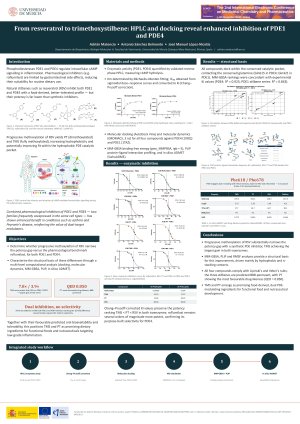
Phosphodiesterases (PDEs) control cyclic nucleotide signaling and are established targets in inflammatory disease, with PDE1 and PDE4 being especially relevant for the regulation of cAMP. Here, we asked whether methylating the hydroxyl groups of resveratrol (RSV), which yields 3,4,5′-trimethoxy-trans-stilbene (TMS), improves its ability to inhibit these two isoenzymes.
Using an optimized HPLC assay that follows cAMP hydrolysis, we determined the kinetic and inhibition parameters of both enzymes. PDE4 showed a higher substrate affinity than PDE1. RSV proved to be a weak inhibitor, whereas TMS was approximately 4-fold (PDE1) and 8-fold (PDE4) more potent. The reference inhibitor roflumilast remained clearly superior, acting in the nanomolar range.
Molecular docking placed RSV, TMS and roflumilast in the same catalytic pocket, in contact with conserved residues such as glutamine. The higher potency of TMS can be explained by its better fit within the hydrophobic active site, which strengthens ligand–enzyme interactions.
These results show that trimethylation boosts the PDE-inhibitory capacity of resveratrol derivatives and point to TMS as a dual PDE1/PDE4 modulator, illustrating the value of combining experimental and computational approaches.
Keywords
Resveratrol; Phosphodiesterases; PDE1; PDE4; Molecular docking.
Poster
V2_Poster_A0_PDE1_PDE4_TMS_1.pdf
Targeting Transcription in Neuroblastoma: Development of Inhibitors of Non-POU Domain-Containing Octamer-Binding Protein NONO
A Metabolomics-Based Investigation of Neem's Therapeutic Effect on Breast Cancer