Event submissions
EventsThe 2nd International Electronic Conference on Medicinal Chemistry and Pharmaceutics
Published
This submission belongs to the session S4. Natural Products and Biopharmaceuticals of the event The 2nd International Electronic Conference on Medicinal Chemistry and Pharmaceutics
Published date
28 Oct, 2026
Academic Editor
 Mary J. Meegan
Citation
Nour Alayan Al Kaddour, Ahmed Hassan Elbanna, Naglaa Saad Ashmawy, A Metabolomics-Based Investigation of Neem's Therapeutic Effect on Breast Cancer, in Proceedings of The 2nd International Electronic Conference on Medicinal Chemistry and Pharmaceutics, 1 November–30 November 2026, MDPI: Basel, Switzerland
Share
Email
Facebook
Twitter
LinkedIn
A Metabolomics-Based Investigation of Neem's Therapeutic Effect on Breast Cancer

Nour Alayan Al Kaddour 1
Ahmed Hassan Elbanna 1
Naglaa Saad Ashmawy 2
1. Department of Pharmaceutical Sciences, Gulf Medical University , United Arab Emirates
2. Department of Pharmaceutical Sciences, Dubai Medical University, United Arab Emirates
Abstract
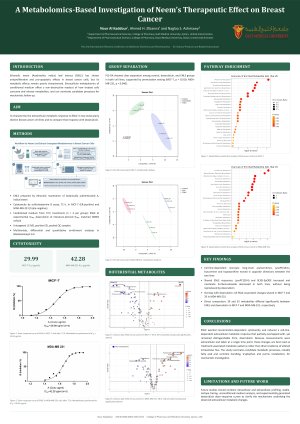
Ethanolic Neem (Azadirachta indica) leaf extract (ENLE) has shown antiproliferative and pro-apoptotic effects in breast cancer cells, but its metabolic effects remain poorly uncharacterized. Previous research has investigated the chemical and biological profiles of Azadirachta indica [1]. This study characterized the extracellular metabolic response to ENLE treatment in two molecularly distinct breast cancer cell lines and compared these responses with doxorubicin.
ENLE was prepared by ethanolic maceration of botanically authenticated Azadirachta indica leaves. Cytotoxicity was assessed by the sulforhodamine B assay after 72 h in MCF-7 (estrogen receptor-positive) and MDA-MB-231 (triple-negative) cells. Conditioned media from 72-h treatments (n = 3 per group) with i) ENLE at experimentally determined IC₃₀ concentrations, ii) doxorubicin at literature-derived IC₃₀ concentrations, and iii) matched DMSO vehicle, were subjected to untargeted LC-MS metabolomic analyses, followed by multivariate, differential and quantitative enrichment analyses using MetaboAnalyst 6.0.
ENLE reduced viability in a concentration-dependent manner, with MCF-7 cells being more sensitive than MDA-MB-231 (IC₅₀ 29.99 versus 42.28 µg/mL, respectively). ENLE significantly altered 49 out of 107 putatively annotated compounds in MCF-7 cells, and 58 out of 118 in MDA-MB-231 cells. Treatment groups showed distinct separation by PCA and PLS-DA in both cell lines, with permutation testing supporting supervised separation. Long-chain acylcarnitines, LysoPE(18:1), kynurenine and hypoxanthine exhibited cell-line-dependent directional changes, whereas LysoPC(20:4) and 9(10)-EpODE increased and nicotinate D-ribonucleoside decreased in both without being reproduced by doxorubicin. Eighteen ENLE-associated changes in MCF-7 and 33 in MDA-MB-231 were shared with doxorubicin, while direct comparison identified respective 39 and 35 significant differences.
In conclusion, ENLE exerted cytotoxic activity and induced a cell-line-dependent extracellular metabolic response that partially overlapped with, yet remained distinguishable from, doxorubicin. These extracellular metabolic changes highlight candidate metabolic pathways and processes for further mechanistic investigation and characterization.
References:
[1] Boukeloua A, Leila S, Bendif H, Mustafa AM, Boga M, Serralheiro ML, Yilmaz MA, Yener I, Garzoli S. A comprehensive study on chemical and biological profiles of Algerian Azadirachta indica (A. Juss). Phytochemistry Letters. 2024 Jun 1;61:89-96.
Keywords
Azadirachta indica; untargeted metabolomics; LC-MS; breast cancer; MCF-7; MDA-MB-231; doxorubicin
Poster
Poster Nour.pdf
From resveratrol to trimethoxystilbene: HPLC and docking reveal enhanced inhibition of PDE1 and PDE4
Potential protective effects of epicatechin against oxidative stress in experimental diabetes