Event submissions
EventsThe 2nd International Electronic Conference on Medicinal Chemistry and Pharmaceutics
Published
This submission belongs to the session S4. Natural Products and Biopharmaceuticals of the event The 2nd International Electronic Conference on Medicinal Chemistry and Pharmaceutics
Published date
28 Oct, 2026
Academic Editor
 Maria Emília Sousa
Contribution&Funding
Conceptualization,
[SURUI A] ; [Dugarmaa Ulzii] ; [Jihai Shi]
Methodology,
[SURUI A]
Validation,
[Enkhtur Yadamsuren]
Formal analysis,
[SURUI A]
Investigation,
[SURUI A]
Data curation,
[SURUI A]
Writing - original draft,
[SURUI A]
Writing - review,
[editing] ; [Enkhtur Yadamsuren] ; [Jihai Shi] ; [Dugarmaa Ulzii]
Visualization,
[SURUI A]
Supervision,
[Dugarmaa Ulzii] ; [Jihai Shi]
Project administration,
[Jihai Shi]
Funding acquisition,
[Jihai Shi]
Funding: This work was supported by the National Natural Science Foundation of China (Grant No. 8236120373).
Citation
SURUI A, Enkhtur Yadamsuren, Dugarmaa Ulzii, Jihai Shi, LUTEOLIN–GADOLINIUM COMPLEX ATTENUATES INFLAMMATORY RESPONSES AND MODULATES STAT3–NLRP3 SIGNALING IN COMPOUND 48/80-STIMULATED HMC-1 CELLS, in Proceedings of The 2nd International Electronic Conference on Medicinal Chemistry and Pharmaceutics, 1 November–30 November 2026, MDPI: Basel, Switzerland
Share
Email
Facebook
Twitter
LinkedIn
LUTEOLIN–GADOLINIUM COMPLEX ATTENUATES INFLAMMATORY RESPONSES AND MODULATES STAT3–NLRP3 SIGNALING IN COMPOUND 48/80-STIMULATED HMC-1 CELLS

SURUI A 1
Enkhtur Yadamsuren 1
Dugarmaa Ulzii 1
Jihai Shi 2
1. Department of Dermatology, School of Medicine, Mongolian National University of Medical Sciences, Ulaanbaatar, 14210, Mongolia
2. Dermatology, Ordos Central Hospital, Ordos, China
Abstract
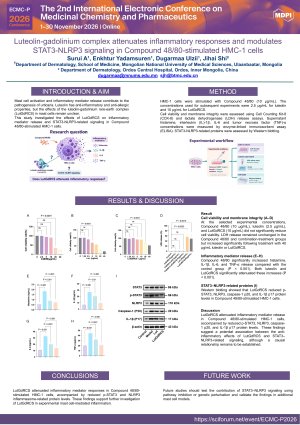
Mast cell activation and inflammatory mediator release are central to the pathogenesis of urticaria. Luteolin has anti-inflammatory and anti-allergic properties; however, the effects and underlying mechanisms of the luteolin–gadolinium rare-earth complex (LutGdRCS) in mast cells remain unclear. This study investigated the effects of LutGdRCS on inflammatory responses and STAT3–NLRP3 signaling in Compound 48/80-stimulated HMC-1 cells. Cell viability and membrane integrity were assessed using Cell Counting Kit-8 and lactate dehydrogenase (LDH) release assays, respectively. Histamine, interleukin (IL)-1β, IL-6, and tumor necrosis factor (TNF)-α concentrations in culture supernatants were quantified by enzyme-linked immunosorbent assay, and proteins associated with STAT3–NLRP3 signaling were assessed by Western blotting. At the concentrations used for subsequent experiments, Compound 48/80 (10 μg/mL), luteolin (2.5 μg/mL), and LutGdRCS (10 μg/mL) did not significantly reduce cell viability or increase LDH release. Compound 48/80 significantly increased histamine, IL-1β, IL-6, and TNF-α concentrations in culture supernatants, whereas luteolin and LutGdRCS significantly attenuated these increases (P < 0.05). Western blotting further showed that LutGdRCS reduced p-STAT3, NLRP3, caspase-1 p20, and IL-1β p17 protein levels in stimulated cells. These findings indicate that LutGdRCS attenuates inflammatory mediator responses in HMC-1 cells and that these effects are associated with reduced p-STAT3 levels and NLRP3 inflammasome signaling, supporting further investigation of LutGdRCS in experimental mast cell-mediated inflammation.
Keywords
mast cell
luteolin–gadolinium
NLRP3 inflammasome
urticaria
Poster
Luteolin–gadolinium complex attenuates inflammatory responses and modulates stat3–nlrp3 signaling in compound 48:80-stimulated hmc-1 cells.pdf
Grape antioxidant dietary fibre regulates intrinsic/extrinsic caspase activity balance and epithelial homeostasis in the colon
Unlocking the Potential of Bee-Derived Bioactives: From Composition to Optimized Encapsulation