Event submissions
EventsThe 2nd International Electronic Conference on Medicinal Chemistry and Pharmaceutics
Published
This submission belongs to the session S4. Natural Products and Biopharmaceuticals of the event The 2nd International Electronic Conference on Medicinal Chemistry and Pharmaceutics
Published date
28 Oct, 2026
Academic Editor
 Francisco Javier Otero Espinar
Contribution&Funding
Funding: The authors gratefully acknowledge financial support from the European Union HORIZON-MSCA through the BEE-TECH project under grant No. 101236756.
Citation
Raluca Alexandra Matei, Larisa - Maria Todorut, Philipp Hopfstock, Rukiye Gündoğan, Tuğçe Ceyhan, Razvan Odocheanu, Adrian Gheorghe Martau, Monica Trif, Lavinia Florina Calinoiu, Tuba Esatbeyoglu, Asli Can Karaça, Dan Cristian Vodnar, Claudia Terezia Socol, Esra Çapanoğlu Güven, Unlocking the Potential of Bee-Derived Bioactives: From Composition to Optimized Encapsulation, in Proceedings of The 2nd International Electronic Conference on Medicinal Chemistry and Pharmaceutics, 1 November–30 November 2026, MDPI: Basel, Switzerland
Share
Email
Facebook
Twitter
LinkedIn
Unlocking the Potential of Bee-Derived Bioactives: From Composition to Optimized Encapsulation

Raluca Alexandra Matei 1
Larisa - Maria Todorut 1
Philipp Hopfstock 2
Rukiye Gündoğan 3
Tuğçe Ceyhan 3
Razvan Odocheanu 4

Adrian Gheorghe Martau 4,5

Monica Trif 6

Lavinia Florina Calinoiu 4,5

Tuba Esatbeyoglu 2

Asli Can Karaça 3

Dan Cristian Vodnar 4,5
Claudia Terezia Socol 1,7

Esra Çapanoğlu Güven 3
1. R&D Department, CENCIRA Agrofood Research and Innovation Centre, Cluj-Napoca, 400650, Romania
2. Department of Molecular Food Chemistry and Food Development, Institute of Food and One Health, Gottfried Wilhelm Leibniz University Hannover, Hannover, 30167, Germany
3. Department of Food Engineering, Faculty of Chemical and Metallurgical Engineering, Istanbul Technical University, Istanbul, Turkey (Türkiye)
4. Faculty of Food Science and Technology, University of Agricultural Sciences and Veterinary Medicine Cluj-Napoca, Cluj-Napoca, 400372, Romania
5. Institute of Life Sciences, University of Agricultural Sciences and Veterinary Medicine Cluj-Napoca, Cluj-Napoca, 400372, Romania
6. Food Research, Centre for innovative process engineering (CENTIV), Syke, Germany
7. Department Of Animal Science And Technology, University of Oradea, Oradea, 410087, Romania
Abstract
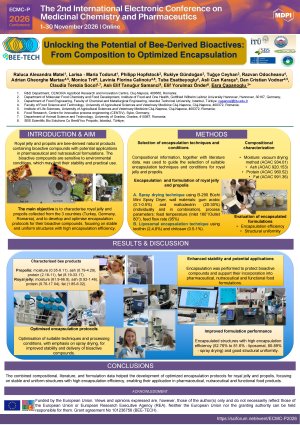
Royal jelly and propolis are bee-derived natural products containing bioactive compounds with potential applications in pharmaceutical and nutraceutical formulations. In the BEE-TECH project, propolis, and royal jelly will first be characterized in terms of moisture, ash, total protein, and fat contents to obtain information on their composition. Moisture will be determined using the vacuum drying method, while ash, protein, and fat contents will be evaluated according to AOAC 920.153, AOAC 960.52, and AOAC 991.36, respectively. This compositional information, together with information reported in the literature, will be used to guide the selection of suitable encapsulation techniques and conditions for royal jelly and propolis. Different encapsulation techniques, including spray drying, fluid-bed drying, freeze drying, and liposome-based encapsulation, will be investigated for the protection and stabilization of their bioactive compounds. Spray drying will be mainly evaluated due to its flexibility, relatively low cost, and ability to produce stable particles. Natural polysaccharides, including gum arabic and maltodextrin, will be used as wall materials, individually and in combination, at different concentrations. Feed temperature, feed flow rate, and core-to-wall material ratio will be studied and optimized. In addition, liposomal encapsulation using lecithin and chitosan will be investigated. The resulting formulations will be evaluated in terms of encapsulation efficiency and structural uniformity. The combined compositional, literature, and formulation data will support the development of optimized encapsulation protocols for royal jelly and propolis, focusing on stable and uniform structures with high encapsulation efficiency.
Keywords
Royal jelly
Propolis
Encapsulation
Spray drying
Bioactive compounds
Poster
Unlocking the Potential of Bee-Derived Bioactives From Composition to Optimized Encapsulation - Poster.pdf
LUTEOLIN–GADOLINIUM COMPLEX ATTENUATES INFLAMMATORY RESPONSES AND MODULATES STAT3–NLRP3 SIGNALING IN COMPOUND 48/80-STIMULATED HMC-1 CELLS
Deciphering the Antioxidant, Hemocompatibility, and Antimicrobial Properties of Artemisia arborescens Essential Oil