Event submissions
EventsThe 2nd International Electronic Conference on Medicinal Chemistry and Pharmaceutics
Published
This submission belongs to the session S4. Natural Products and Biopharmaceuticals of the event The 2nd International Electronic Conference on Medicinal Chemistry and Pharmaceutics
Published date
28 Oct, 2026
Academic Editor
 Alfredo Berzal-Herranz
Contribution&Funding
Funding: No funding
Citation
Majdouline Aziz, Zaynab Ouadghiri, Rim Rais, Maria Tijini, Najma Lefjel, Othman El faqer, Nadia Ziyate, Samira Rais, El Mostafa Mtairag, Deciphering the Antioxidant, Hemocompatibility, and Antimicrobial Properties of Artemisia arborescens Essential Oil, in Proceedings of The 2nd International Electronic Conference on Medicinal Chemistry and Pharmaceutics, 1 November–30 November 2026, MDPI: Basel, Switzerland
Share
Email
Facebook
Twitter
LinkedIn
Deciphering the Antioxidant, Hemocompatibility, and Antimicrobial Properties of Artemisia arborescens Essential Oil

Majdouline Aziz 1,2
Zaynab Ouadghiri 1
Rim Rais 3
Maria Tijini 1,2
Najma Lefjel 1,2
Othman El faqer 1
Nadia Ziyate 4
Samira Rais 1,2
El Mostafa Mtairag 1
1. Laboratory of Integrative Biology, Faculty of Sciences Ain Chock, Hassan II university of Casablanca, Casablanca, 20200, Morocco
2. Department of Biology, Faculty of Sciences Ben M’Sick, Hassan II university of Casablanca, Casablanca, 20200, Morocco
3. Laboratory of Human Pathologies Biology, Department of Biology, Faculty of Sciences, Mohammed V University in Rabat, Morocco
4. National Laboratory for Veterinary Medicine Control, ONSSA, Morocco
Abstract
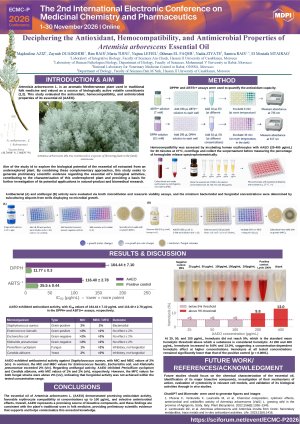
Introduction: Artemisia arborescens L. is an aromatic Mediterranean plant used in traditional folk medicine and valued as a source of biologically active volatile constituents (1,2). This study evaluated the antioxidant, hemocompatibility, and antimicrobial properties of its essential oil (AAEO).
Materials and Methods: DPPH• and ABTS•+ assays were used to quantify the antioxidant capacity. Hemocompatibility was assessed by incubating human erythrocytes with AAEO (25-400 µg/mL) for 30 minutes at 37°C, then measuring the percentage of hemoglobin release spectrophotometrically. Antibacterial and antifungal activity were evaluated via broth microdilution and resazurin viability assays, and the minimum bactericidal and fungicidal concentrations were determined by subculturing aliquots from wells displaying no microbial growth.
Results and Discussion: AAEO exhibited antioxidant activity, with IC₅₀ values of 164.44 ± 7.10 µg/mL and 116.40 ± 2.78 µg/mL in the DPPH• and ABTS•+ assays, respectively. At 25, 50, and 100 µg/mL, hemolysis did not reach 5%, which is the standard mean hemolytic threshold above which a substance is considered hemolytic. At 200 and 400 µg/mL, hemolysis increased to 9.8% and 13.0%, suggesting a concentration-dependent hemolytic effect at higher concentrations. Hemolysis at all tested concentrations remained significantly lower than that of the positive control (p < 0.0001). AAEO inhibited Staphylococcus aureus with an MIC and MBC of 2% (v/v), whereas those values for Enterococcus faecalis, Escherichia coli, and Klebsiella pneumoniae were >2% (v/v). Antifungal activity was observed against Penicillium cyclopium and Candida albicans, with MIC values of 1% and 2% (v/v), respectively. MFC values were >2% (v/v) for both fungi, indicating no fungicidal activity within the tested concentration range. Overall, AAEO demonstrated antioxidant activity, favorable erythrocyte compatibility at concentrations up to 100 µg/mL, while higher concentrations produced a measurable hemolytic response and selective antimicrobial effects.
References
1. Plescia F, Venturella F, Lauricella M, et al. Chemical composition, cytotoxic effects, antimicrobial and antibiofilm activity of Artemisia arborescens (Vaill.) L. growing wild in the province of Agrigento, Sicily, Italy. Plant Biosystems. 2022;156(6):1336–1345.
2. Lantzouraki DZ, et al. Artemisia arborescens and Artemisia inculta from Crete: Secondary metabolites, trace metals and in vitro antioxidant activities. Life. 2023;13(6):1416.
Keywords
Artemisia arborescens
essential oil
antioxidant activity
hemocompatibility
antimicrobial activity
Poster
Poster.pdf
Unlocking the Potential of Bee-Derived Bioactives: From Composition to Optimized Encapsulation
Effects of fisetin on peroxynitrite concentration and amyloid content in the hypothalamus and cerebral cortex of rats with type 2 diabetes