Event submissions
EventsThe 2nd International Electronic Conference on Medicinal Chemistry and Pharmaceutics
Published
This submission belongs to the session S4. Natural Products and Biopharmaceuticals of the event The 2nd International Electronic Conference on Medicinal Chemistry and Pharmaceutics
Published date
28 Oct, 2026
Academic Editor
 Alfredo Berzal-Herranz
Contribution&Funding
Conceptualization,
[Lavinia Dorothea Frau-Vaughn Joseph]
Methodology,
[Lavinia Dorothea Frau-Vaughn Joseph]
Software,
[Lavinia Dorothea Frau-Vaughn Joseph]
Investigation,
[Lavinia Dorothea Frau-Vaughn Joseph]
Data curation,
[Lavinia Dorothea Frau-Vaughn Joseph]
Writing - original draft,
[Lavinia Dorothea Frau-Vaughn Joseph]
Writing - review,
[editing] ; [Lavinia Dorothea Frau-Vaughn Joseph]
Visualization,
[Lavinia Dorothea Frau-Vaughn Joseph]
Supervision,
[Hicham Oumzil]
Funding: --
Citation
Lavinia Dorothea Frau-Vaughn Joseph, Hicham Oumzil, Prioritising Flavonoids Reported in Moroccan Honeys against Influenza A Neuraminidase Structures using Docking Scores and Ligand Efficiency. , in Proceedings of The 2nd International Electronic Conference on Medicinal Chemistry and Pharmaceutics, 1 November–30 November 2026, MDPI: Basel, Switzerland
Share
Email
Facebook
Twitter
LinkedIn
Prioritising Flavonoids Reported in Moroccan Honeys against Influenza A Neuraminidase Structures using Docking Scores and Ligand Efficiency.

Lavinia Dorothea Frau-Vaughn Joseph 1
Hicham Oumzil 2
1. Molecular Virology and Onco-Biology Research Team, University Mohammed V, Faculty of Medicine and Pharmacy, Rabat, 10005, Morocco
2. Virology/Microbiology, University Mohammed V, Faculty of Medicine and Pharmacy, Rabat, 10005, Morocco
Abstract
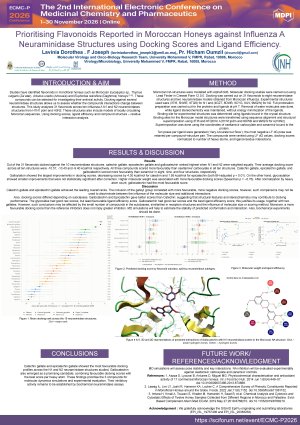
Flavonoids found in honey have been studied for their potential antiviral activity. However, assessing these compounds against a single protein structure does not account for structural variability between targets. Also, it does not show if the compound rankings are consistent across the structures. This study compared the binding profiles of flavonoids reported in Moroccan honeys across multiple influenza A N1 and N2 neuraminidase structures. These flavonoids were studied as candidate complementary antivirals rather than replacements for existing neuraminidase inhibitors.
Molecular docking of 31 flavonoids was performed against ten protein structures: three experimentally determined N1 structures, five experimentally determined N2 structures, and N1 and N2 models based on Moroccan influenza sequences. Oseltamivir, zanamivir and sialic acid were included as reference ligands. Compounds were prioritised primarily using docking scores (LeadFinder LF dG) and ligand efficiency (LF LE). Their physicochemical drug-likeness descriptors were also evaluated.
Catechin gallate and epicatechin gallate ranked first or second on nine out of ten structures, with the most favourable docking score reaching -11.96 kcal/mol. Across the structures, reference ligands scored -6.9 to -9.7 kcal/mol (oseltamivir) and -8.7 to -11.7 kcal/mol (zanamivir). Both gallates received more favourable docking scores than oseltamivir on every structure and scores equal to or more favourable than zanamivir on most. Compound rankings showed strong agreement across the structures, including the Moroccan models (Kendall's W = 0.79, p < 10-30). Gallocatechin ranked third on every structure but had the most favourable ligand efficiency in the series (-0.42 kcal/mol per heavy atom, comparable to zanamivir under the same protocol), with a molecular weight of 306 Da.
These results support selecting gallocatechin and the gallated catechins for molecular dynamics simulations and experimental testing. The docking-score rankings were not dependent on any single protein structure. These predictions do not establish neuraminidase inhibition or antiviral activity.
Keywords
Influenza A virus
neuraminidase
molecular docking
flavonoids
honey
ligand efficiency
gallocatechin
Morocco
Poster
Lavinia Dorothea F Joseph - Poster.pdf
Effects of fisetin on peroxynitrite concentration and amyloid content in the hypothalamus and cerebral cortex of rats with type 2 diabetes
Unlocking the Antioxidant Potential of Wild Bilberry (Vaccinium myrtillus L.) Pomace through Design of Experiments