Event submissions
EventsThe 2nd International Electronic Conference on Medicinal Chemistry and Pharmaceutics
Published
This submission belongs to the session S4. Natural Products and Biopharmaceuticals of the event The 2nd International Electronic Conference on Medicinal Chemistry and Pharmaceutics
Published date
28 Oct, 2026
Academic Editor
 Maria Emília Sousa
Contribution&Funding
Funding: This work was supported by Fondazione CARIPT, Call No. 6/2025.
Citation
Nilofar Nilofar, Elena Tomassi, Ilaria D'Agostino, Nafiou Arouna, Bianca Laura Bernardoni, Lidia Ciccone, Laura Pucci, Concettina La Motta, Unlocking the Antioxidant Potential of Wild Bilberry (Vaccinium myrtillus L.) Pomace through Design of Experiments, in Proceedings of The 2nd International Electronic Conference on Medicinal Chemistry and Pharmaceutics, 1 November–30 November 2026, MDPI: Basel, Switzerland
Share
Email
Facebook
Twitter
LinkedIn
Unlocking the Antioxidant Potential of Wild Bilberry (Vaccinium myrtillus L.) Pomace through Design of Experiments

Nilofar Nilofar 1
Elena Tomassi 2

Ilaria D'Agostino 1

Nafiou Arouna 2

Bianca Laura Bernardoni 1

Lidia Ciccone 1

Laura Pucci 2

Concettina La Motta 1
1. Department of Pharmacy, University of Pisa, Pisa, 56126, Italy
2. Institute of Agricultural Biology and Biotechnology, National Research Council Pisa, Pisa, 56124, Italy
Abstract
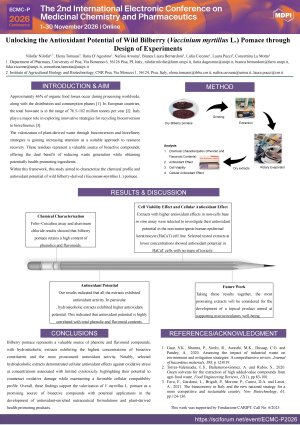
The valorization of plant-derived waste through bioconversion and biorefinery strategies is gaining increasing attention as a suitable approach to resource recovery. These residues represent a valuable source of bioactive compounds, offering the dual benefit of reducing waste generation while obtaining potentially health-promoting ingredients.
Within this framework, this study aimed to characterize the chemical profile and antioxidant potential of wild bilberry-derived (Vaccinium myrtillus L.) pomace. A mathematical and statistical approach based on the Box-Behnken design of experiments was used to optimize the extraction process. Thirteen maceration experiments were designed to extract polyphenolic components from V. myrtillus pomace. The total phenolic and flavonoid contents of extracts were determined by the Folin–Ciocalteu assay and aluminum chloride colorimetric assay, respectively.
Non-cell-based radical scavenging assays, i.e., DPPH and ABTS, and the ferric reducing antioxidant power (FRAP) assay were performed to evaluate the antioxidant potential. In addition, cytocompatibility and antioxidant assays were carried out to investigate the antioxidant activity of the extracts in HaCaT cells.
The results showed that all the extracts of V. myrtillus were rich of phenolic and flavonoids, and exhibited high radical scavenging and reducing power effects. Selected tested extracts at their lower concentration showed antioxidant potential in HaCaT cells with no signs of toxicity. Taking these results together, the most promising extracts will be considered for the development of a topical product aimed at supporting microcirculatory well-being.
In conclusion, this ongoing research offers valuable data to support the use of V. myrtillus pomace extracts for therapeutic purposes.
Keywords
Vaccinium myrtillus
bilberry
phenolic
antioxidant
cell viability.
Poster
Poster_Nilofar.pdf
Prioritising Flavonoids Reported in Moroccan Honeys against Influenza A Neuraminidase Structures using Docking Scores and Ligand Efficiency.
Structural Features of Grayanotoxins II and III and Their Affinity for Human Carbonic Anhydrase I: A Molecular Docking Study