Event submissions
EventsThe 2nd International Electronic Conference on Medicinal Chemistry and Pharmaceutics
Published
This submission belongs to the session S4. Natural Products and Biopharmaceuticals of the event The 2nd International Electronic Conference on Medicinal Chemistry and Pharmaceutics
Published date
28 Oct, 2026
Academic Editor
 Alfredo Berzal-Herranz
Contribution&Funding
Conceptualization,
[Ekaterina Alexandrovna Popova]
Methodology,
[Konstantin Andreevich Sukhomlin ]
Investigation,
[Konstantin Andreevich Sukhomlin ]
Writing - original draft,
[Konstantin Andreevich Sukhomlin ]
Writing - review,
[editing] ; [Ekaterina Alexandrovna Popova]
Supervision,
[Ekaterina Alexandrovna Popova]
Funding: --
Citation
Ekaterina Alexandrovna Popova, Konstantin Andreevich Sukhomlin , Structural Features of Grayanotoxins II and III and Their Affinity for Human Carbonic Anhydrase I: A Molecular Docking Study, in Proceedings of The 2nd International Electronic Conference on Medicinal Chemistry and Pharmaceutics, 1 November–30 November 2026, MDPI: Basel, Switzerland
Share
Email
Facebook
Twitter
LinkedIn
Structural Features of Grayanotoxins II and III and Their Affinity for Human Carbonic Anhydrase I: A Molecular Docking Study

Ekaterina Alexandrovna Popova 1
Konstantin Andreevich Sukhomlin 1
1. Department of General and Medical Chemistry named after Prof. V.V. Khorunzhiy, Saint Petersburg State Pediatric Medical University, Ministry of Health of the Russian Federation, St.Petersburg, 194100, Russia
Abstract
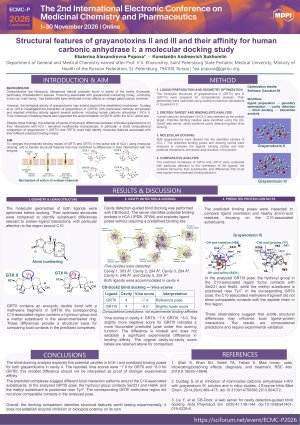
Grayanotoxins are tetracyclic diterpenoid compounds of plants of the family Ericaceae, including the genus Rhododendron. Grayanotoxins are traditionally believed to target voltage-gated sodium channels, but an extract of honey containing Rhododendron ponticum pollen was recently shown to inhibit metal-dependent carbonic anhydrase, an effect attributed to grayanotoxin III (GRTIII). Since such honey may contain other grayanotoxin forms as well, a comparative study of their binding to human carbonic anhydrase is of interest. The aim of this work was to perform molecular docking of grayanotoxin II (GRTII) and grayanotoxin III (GRTIII) into the active site of human carbonic anhydrase I (hCA I) and to identify differences in their binding mechanisms as forms with different toxicity. The geometries of GRTII and GRTIII were optimized in Gaussian 9.0 with reference to X-ray diffraction data (GRTIICCDC:1170390, GRTIIICCDC:1246563); docking was carried out using the CB-DOCK2 method against the hCA I structure (RCSBPDB2FW4). Structurally, GRTII and GRTIII differ in the environment of the tenth carbon atom of the framework: in GRTIII it bears a hydroxyl group and a methyl radical, whereas in GRTII it is involved in an exocyclic double bond with a methylene fragment. According to the docking results, these groups at C10 of the seven-membered ring of GRTIII provide additional binding to hCA I: the methyl radical interacts with tyrosine (Tyr7), and the hydroxyl group interacts with serine (Ser231) and histidine (His64). For GRTII, no binding through this fragment is observed. The stronger binding of GRTIII to the active sites of hCA I was shown to be due to the presence of a hydroxyl group and a methyl radical in the seven-membered ring of the toxin; the results are consistent with published data on the relative toxicity of GRTII and GRTIII.
Keywords
grayanotoxins
carbonic anhydrase
molecular docking
CB-DOCK2
receptor
Poster
GTX_Popova_Sukhomlin.pdf
Unlocking the Antioxidant Potential of Wild Bilberry (Vaccinium myrtillus L.) Pomace through Design of Experiments
A Natural HSV‑1 Replication Inhibitor Based on Tagetes patula Extract