Event submissions
EventsThe 2nd International Electronic Conference on Medicinal Chemistry and Pharmaceutics
Published
This submission belongs to the session S4. Natural Products and Biopharmaceuticals of the event The 2nd International Electronic Conference on Medicinal Chemistry and Pharmaceutics
Published date
28 Oct, 2026
Academic Editor
 Mary J. Meegan
Citation
Liubov Zelena, Liubov Oleksiivna Artiukh (Biliavska), Galyna Baranova, Svitlana Zahorodnia, A Natural HSV‑1 Replication Inhibitor Based on Tagetes patula Extract, in Proceedings of The 2nd International Electronic Conference on Medicinal Chemistry and Pharmaceutics, 1 November–30 November 2026, MDPI: Basel, Switzerland
Share
Email
Facebook
Twitter
LinkedIn
A Natural HSV‑1 Replication Inhibitor Based on Tagetes patula Extract

Liubov Zelena 1
Liubov Oleksiivna Artiukh (Biliavska) 1
Galyna Baranova 1
Svitlana Zahorodnia 1
1. Department of Virus Reproduction, D.K. Zabolotny Institute of Microbiology and Virology, National Academy of Sciences of Ukraine, Kyiv, Ukraine
Abstract
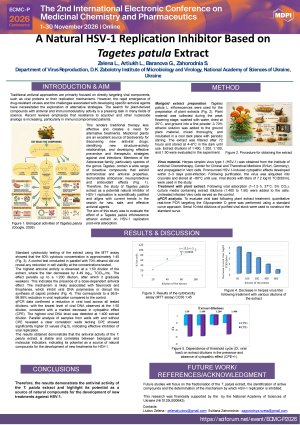
The relevance of this study stems from the increasing resistance of herpes simplex virus type 1 (HSV‑1) to traditional antiviral drugs and the need to identify novel plant-derived bioactive compounds inhibiting viral replication without promoting resistance. Plants of the genus Tagetes are known for a high content of terpenes, flavonoids, and other metabolites that may exhibit antiviral activity; therefore, their investigation provides a promising basis for the development of new plant‑based therapeutics.
The aim of this study was to evaluate the effect of a Tagetes patula inflorescence ethanol extract on HSV-1 replication post-viral adsorption. Plant material was washed, dried at 25°C, ground (2 g), homogenized in a mortar, and extracted in 20 mL of 70% ethanol (72 h, cool dark place, periodic stirring). The extract was filtered and stored at 4–6°C in the dark until use. Following viral adsorption (1–1.5 h, 37°C, 5% CO₂), culture medium containing extract dilutions (1:400 to 1:50) was added to the cells. Untreated infected Vero cells served as the control. Quantitative assessment of viral DNA was performed by qPCR using a standard curve.
The infectivity titration results demonstrated that the extract exerted a pronounced antiviral effect at dilutions of 1:50–1:200, reducing the HSV‑1 titer by 4.49–2.9 log10 TCID50/mL. qPCR data confirmed a reduction in viral load across all tested dilutions, with the lowest level of viral DNA observed at the 1:50 dilution, consistent with a marked decrease in cytopathic effect (CPE). The highest viral DNA level was detected at 1:400 extract dilution. Parallel analysis of samples from wells with and without CPE revealed a clear correlation: wells lacking CPE showed significantly higher Ct values, indicating effective inhibition of viral replication.
Overall, the results demonstrate the antiviral activity of the T. patula extract and highlight its potential as a source of natural compounds for the development of new treatments against HSV‑1.
Keywords
plant-derived compounds
herpes simplex virus type 1
qPCR
Poster
poster_Zelena et al.pdf
Structural Features of Grayanotoxins II and III and Their Affinity for Human Carbonic Anhydrase I: A Molecular Docking Study
Bee Podmore Extract Modulates Osteogenic Differentiation of Metabolically Impaired Mesenchymal Stromal Cells