Event submissions
EventsThe 2nd International Electronic Conference on Medicinal Chemistry and Pharmaceutics
Published
This submission belongs to the session S4. Natural Products and Biopharmaceuticals of the event The 2nd International Electronic Conference on Medicinal Chemistry and Pharmaceutics
Published date
28 Oct, 2026
Academic Editor
 Maria Emília Sousa
Citation
Lynda Bourebaba, Krzysztof Jurkowski, Nabila Bourebaba, Bee Podmore Extract Modulates Osteogenic Differentiation of Metabolically Impaired Mesenchymal Stromal Cells, in Proceedings of The 2nd International Electronic Conference on Medicinal Chemistry and Pharmaceutics, 1 November–30 November 2026, MDPI: Basel, Switzerland
Share
Email
Facebook
Twitter
LinkedIn
Bee Podmore Extract Modulates Osteogenic Differentiation of Metabolically Impaired Mesenchymal Stromal Cells

Lynda Bourebaba 1
Krzysztof Jurkowski 1
Nabila Bourebaba 2
1. Department of Experimental Biology, Wroclaw University of Environmental and Life Sciences, Wrocław, 50-375, Poland
2. Department of Bees Breeding, University of Environmental and Life Sciences, Wrocław, 51-630, Poland
Abstract
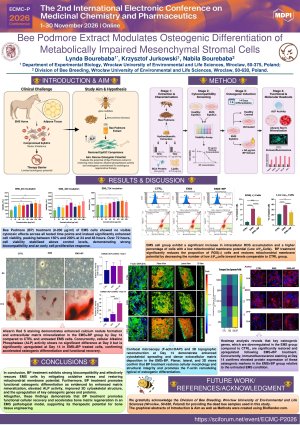
Equine metabolic syndrome (EMS) is a naturally occurring endocrine-metabolic disorder that compromises the survival, redox balance, and regenerative competence of adipose-derived mesenchymal stromal cells (EqASCs), limiting their value for autologous cell-based therapy. This study examined whether a hydroethanolic extract of Bee Podmore (BP), the chemically heterogeneous biomass of deceased Apis mellifera workers, could restore the osteogenic potential of EMS-derived EqASCs in vitro. The extract was characterized at the compound-class level (total phenolic content 45.4 µg GAE/mg, total flavonoid content 5.7 µg QE/mg, BCA-reactive protein equivalent 460 µg/mg, total lipid equivalent 470.3 µg cholesterol-equivalent/mg). Cytocompatibility screening in healthy control and EMS-derived EqASCs identified 60 µg/mL as a conservative, non-cytotoxic working concentration, which was applied to EMS-derived cells during osteogenic induction. Relative to untreated EMS cells, BP treatment restored alkaline phosphatase activity and increased Alizarin Red S-detectable mineralization. This functional recovery was accompanied by reactivation of a coordinated osteogenic gene-expression and protein-distribution program, with upregulation of RUNX2, BMP4, COL1A1, BGLAP, and SPP1 relative to untreated EMS cells. Together, these findings indicate that Bee Podmore, a multi-component apiary by-product, can partially reverse the osteogenic impairment characteristic of EMS-derived EqASCs, supporting its potential as a bioactive supplement to improve the regenerative competence of metabolically compromised stromal cells for future autologous cell-based therapeutic applications in horses.
Keywords
Equine metabolic syndrome; Adipose-derived mesenchymal stromal cells; Bee Podmore; Osteogenic differentiation; Cell-based therapy
Poster
Bourebaba et al._ECMC 2026.pdf
A Natural HSV‑1 Replication Inhibitor Based on Tagetes patula Extract
FORMULATION AND CHARACTERIZATION OF A NATURAL FACIAL MASK INCORPORATING MUSA SPP. PEEL, CITRULLUS LANATUS RIND, AND CENTELLA ASIATICA AQUEOUS EXTRACTS