Event submissions
EventsThe 2nd International Electronic Conference on Medicinal Chemistry and Pharmaceutics
Published
This submission belongs to the session S4. Natural Products and Biopharmaceuticals of the event The 2nd International Electronic Conference on Medicinal Chemistry and Pharmaceutics
Published date
28 Oct, 2026
Academic Editor
 Maria Emília Sousa
Contribution&Funding
Conceptualization,
[Aku Enam MOTTO]
Methodology,
[Aku Enam MOTTO]
Formal analysis,
[Aku Enam MOTTO]
Investigation,
[Aku Enam MOTTO]
Data curation,
[Aku Enam MOTTO]
Funding: --
Citation
Aku Enam MOTTO, Poyodi Kola, G’massampou Datagni, Povi Lawson-Evi, Kwashie Eklu-Gadegbeku, Anogeissus leiocarpus roots as a promising source of potent antimicrobial and antioxidant agents, in Proceedings of The 2nd International Electronic Conference on Medicinal Chemistry and Pharmaceutics, 1 November–30 November 2026, MDPI: Basel, Switzerland
Share
Email
Facebook
Twitter
LinkedIn
Anogeissus leiocarpus roots as a promising source of potent antimicrobial and antioxidant agents

Aku Enam MOTTO 1
Poyodi Kola 2
G’massampou Datagni 1
Povi Lawson-Evi 1
Kwashie Eklu-Gadegbeku 1
1. Laboratory of Physiology/Pharmacology, Unit of Pathophysiology, Bioactive Substances and Safety, Faculty of Sciences, University of Lomé, Lomé, Togo
2. Laboratory of Applied Agronomic and Biological Sciences (LaSABA), Faculty of Sciences and Techniques, University of Kara, Kara, Togo
Abstract
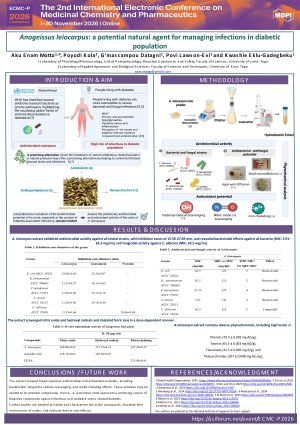
Background: Infections pose an increasing health burden in people living with diabetes, and it worsened by antimicrobial resistance.
Objective: This study assessed the antimicrobial and antioxidant properties of Anogeissus leiocarpus.
Materials and methods: Five different bacterial and fungal strains were tested: Escherichia coli ATCC 25922, Klebsiella pneumoniae ATCC 700603, Pseudomonas aeruginosa ATCC 27853, Staphylococcus aureus ATCC 29213, and Candida albicans ATCC 35659.
The Antimicrobial activity of the hydroethanolic extract of Anogeissus leiocarpus roots was determined by agar well diffusion (inhibition zone diameters). The minimum inhibitory concentration (MIC) and minimum microbicidal concentration (MMC) were measured using the broth dilution method. The in vitro antioxidant potential was assessed through the hydroxyl radical scavenging, Nitric oxide scavenging, and iron chelating assays.
Results: The hydroethanolic extract of Anogeissus leiocarpus roots exhibited broad-spectrum antimicrobial activity with MIC values ranging from 3.91 to 62.5 mg/mL, inhibiting both Gram-positive and Gram-negative bacteria (19.90 - 27.09 mm) and Candida albicans (15.59mm). The extract showed bactericidal and fungicidal activities against the five different bacterial and fungal strains, with MBC/MIC and MFC/MIC ratios ≤ 4. Staphylococcus aureus strain with the lowest MIC (MIC = 3.91 mg/mL) was the most susceptible among the Gram-positive strains. In vitro, it also demonstrated concentration-dependent antioxidant activity by scavenging the NO and OH radicals and chelating Fe ions.
Conclusion: These findings indicate that Anogeissus leiocarpus roots could serve as a natural source of antimicrobial and antioxidant agents, potentially useful in managing infections commonly associated with the diabetic population.
Keywords
A. leiocarpus roots antibacterial
antifungal
antioxidant
in vitro
Poster
Poster_Sciforum-211341.pdf
Novel methodology for the isolation of soyasaponin as an innovative sialic acid inhibitor with characterisation, and biological evaluation
Solvent-Dependent Phenolic Recovery and Biological Activities of Olive Pomace Extracts