Event submissions
EventsThe 2nd International Electronic Conference on Medicinal Chemistry and Pharmaceutics
Published
This submission belongs to the session S4. Natural Products and Biopharmaceuticals of the event The 2nd International Electronic Conference on Medicinal Chemistry and Pharmaceutics
Published date
28 Oct, 2026
Academic Editor
 Maria Emília Sousa
Contribution&Funding
Conceptualization,
[Patrícia Rijo]
Methodology,
[Patrícia Rijo] ; [Rebeca André]
Validation,
[Patrícia Rijo]
Formal analysis,
[Rebeca André] ; [Vera M. S. Isca]
Investigation,
[Vera M. S. Isca] ; [Inês Saraiva] ; [Rebeca André]
Resources,
[Patrícia Rijo]
Data curation,
[Patrícia Rijo]
Writing - original draft,
[Rebeca André]
Supervision,
[Rebeca André] ; [Patrícia Rijo]
Project administration,
[Rebeca André] ; [Patrícia Rijo]
Funding acquisition,
[Patrícia Rijo]
Funding: This work was developed within the framework of the Olive2New project (COFAC/ILIND/CBIOS/2/2025; https://doi.org/10.62658/COFAC/ILIND/CBIOS/2/2025
Citation
Rebeca André, Inês Saraiva, Vera M. S. Isca, Patrícia Rijo, Solvent-Dependent Phenolic Recovery and Biological Activities of Olive Pomace Extracts, in Proceedings of The 2nd International Electronic Conference on Medicinal Chemistry and Pharmaceutics, 1 November–30 November 2026, MDPI: Basel, Switzerland
Share
Email
Facebook
Twitter
LinkedIn
Solvent-Dependent Phenolic Recovery and Biological Activities of Olive Pomace Extracts

Rebeca André 1,2

Inês Saraiva 1

Vera M. S. Isca 1,3

Patrícia Rijo 1,2,3,4
1. CBIOS - Center for Research in Biosciences and Health Technologies, Lusofona University, Lisbon, Portugal
2. Centro de Química Estrutural, Institute of Molecular Sciences, Lisbon University, Lisbon, Portugal
3. Research Institute for Medicines (iMed.ULisboa), Faculty of Farmacy, Lisbon University, Lisbon, Portugal
4. Faculty of Biology and Environmental Protection, University of Lodz, Lodz, Poland
Abstract
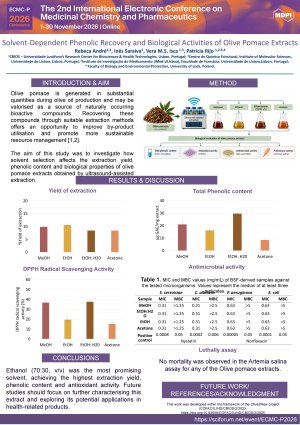
Olive pomace, a by-product of the olive oil industry, represents an underexploited source of bioactive compounds with potential health applications. Their recovery is influenced by extraction conditions, particularly solvent polarity, which may affect extract composition and biological activity. This study aimed to evaluate the influence of extraction solvent on the phenolic content and biological properties of olive pomace extracts. Extracts were obtained by ultrasound-assisted extraction using methanol, ethanol, ethanol:water (70:30, v/v), and acetone. Extraction yield was determined gravimetrically, while total phenolic content was quantified using the Folin–Ciocalteu method. Antioxidant activity was assessed using the DPPH radical scavenging assay. Antimicrobial activity was evaluated against bacterial and yeast strains through minimum inhibitory concentration (MIC) and minimum bactericidal concentration (MBC) assays. Preliminary toxicity was assessed using the Artemia salina lethality model. Solvent selection influenced extraction yield and phenolic recovery. The ethanol:water extract showed the highest extraction yield (10.56%) and total phenolic content (29.53 mg GAE/g extract), followed by methanol (20.92 mg GAE/g extract). Ethanol:water and methanol extracts also exhibited the highest DPPH scavenging activity, reaching approximately 37% inhibition. Antimicrobial activity was comparable among the extracts for most tested microorganisms. For Enterococcus faecalis, the acetone extract showed the lowest MIC (78.1 µg/mL), compared with 156.3 µg/mL for methanol and 312.5 µg/mL for the remaining extracts. Overall, these findings demonstrate that solvent selection affects phenolic recovery and antioxidant activity, while antimicrobial activity showed a less pronounced dependence on extraction solvent.
Keywords
Olive pomace
Phenolic compounds
Antioxidant activity
Antimicrobial activity
Poster
Rebeca André poster.pdf
Anogeissus leiocarpus roots as a promising source of potent antimicrobial and antioxidant agents
Phytochemical characterization and evaluation of the antiproliferative activity of Chelidonium majus extract in tumor cell models