Event submissions
EventsThe 2nd International Electronic Conference on Medicinal Chemistry and Pharmaceutics
Published
This submission belongs to the session S4. Natural Products and Biopharmaceuticals of the event The 2nd International Electronic Conference on Medicinal Chemistry and Pharmaceutics
Published date
28 Oct, 2026
Academic Editor
 Maria Emília Sousa
Contribution&Funding
Conceptualization,
[Mirela Antonela Mihaila]
Methodology,
[Mirela Antonela Mihaila] ; [Mariana Popescu] ; [CARMEN ELISABETA MANEA] ; [Mona Luciana Galatanu] ; [Viviana Roman]
Software,
[Viviana Roman] ; [Carmen Marinela Mihăilescu] ; [Marinela Bostan]
Validation,
[Mariana Panturoiu] ; [Mariana Popescu]
Formal analysis,
[Mona Luciana Galatanu] ; [Mariana Panturoiu] ; [Marinela Bostan]
Data curation,
[CARMEN ELISABETA MANEA] ; [Carmen Marinela Mihăilescu]
Writing - original draft,
[Mirela Antonela Mihaila]
Writing - review,
[editing] ; [Mirela Antonela Mihaila]
Visualization,
[Carmen Marinela Mihăilescu]
Supervision,
[Marinela Bostan]
Funding: --
Citation
Mirela Antonela Mihaila, Viviana Roman, Mona Luciana Galatanu, Mariana Panturoiu, CARMEN ELISABETA MANEA, Carmen Marinela Mihăilescu, Mariana Popescu, Marinela Bostan, Phytochemical characterization and evaluation of the antiproliferative activity of Chelidonium majus extract in tumor cell models, in Proceedings of The 2nd International Electronic Conference on Medicinal Chemistry and Pharmaceutics, 1 November–30 November 2026, MDPI: Basel, Switzerland
Share
Email
Facebook
Twitter
LinkedIn
Phytochemical characterization and evaluation of the antiproliferative activity of Chelidonium majus extract in tumor cell models

Mirela Antonela Mihaila 1,2

Viviana Roman 1
Mona Luciana Galatanu 2
Mariana Panturoiu 2
CARMEN ELISABETA MANEA 2,3
Carmen Marinela Mihăilescu 2,4
Mariana Popescu 2
Marinela Bostan 1
1. Center of Immunology, Stefan S. Nicolau Institute of Virology, Bucharest, 030304, Romania
2. Pharmacy Faculty, Titu Maiorescu University, Bucharest, 040314, Romania
3. IFIN-HH, Horia Hulubei National Institute for R&D in Physics and Nuclear Engineering , Magurele, 077125, Romania
4. IMT, National Institute for Research and Development in Microtechnologies, Bucharest, 077190, Romania
Abstract
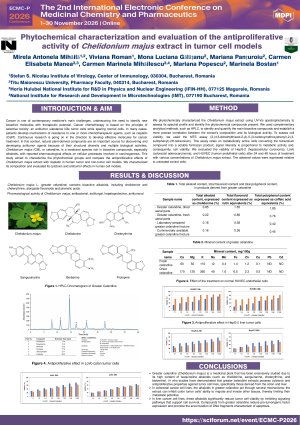
Cancer is one of the main challenges of contemporary medicine, determining the need to identify new bioactive molecules with therapeutic potential. In this context, natural plant-derived compounds are an important source for discovering and developing antitumor agents because of their structural diversity and multiple biological activities. Chelidonium majus (CM), known as celandine, is a medicinal species rich in bioactive compounds, especially alkaloids, with reported pharmacological effects, including on cellular processes involved in carcinogenesis.
This study aimed to characterize the composition of Chelidonium majus extract and evaluate its cytotoxic and antitumor effects in human cell models. We investigated the extract's biological activity using the tumor cell lines HepG-2 (hepatocellular carcinoma) and LoVo (colorectal adenocarcinoma), as well as the non-tumor cell line HUVEC (human endothelial cells). Cisplatin (CisPt) served as the reference agent. Cells were treated with different concentrations of CM extract for 24 and 48 hours, and cell viability was evaluated quantitatively.
CM extract treatment significantly reduced tumor cell viability in a concentration-dependent manner. At 1:8 dilution, cell viability was reduced to approximately 42%, compared to 58% in the case of CisPt, while the effect on HUVEC cells was reduced. These data indicate a differential cytotoxic profile of the CM extract, with a possible selectivity for tumor cells.
Overall, the results demonstrate the biological potential of Chelidonium majus extract as a source of compounds with antitumor activity and support further investigation of the cellular and molecular mechanisms involved. Characterizing these mechanisms could help evaluate natural compounds as potential therapeutic agents or adjuvants to conventional antineoplastic treatments.
Keywords
Chelidonium majus
natural compounds
antitumor activity
cell viability
Poster
Poster Mirela Mihaila.pdf
Solvent-Dependent Phenolic Recovery and Biological Activities of Olive Pomace Extracts
Larvicidal activity of Dialium cochinchinense (Velvet Tamarind) fruit extract against mosquito larvae