Event submissions
EventsThe 2nd International Electronic Conference on Medicinal Chemistry and Pharmaceutics
Published
This submission belongs to the session S4. Natural Products and Biopharmaceuticals of the event The 2nd International Electronic Conference on Medicinal Chemistry and Pharmaceutics
Published date
28 Oct, 2026
Academic Editor
 Alfredo Berzal-Herranz
Citation
Pálma Porrogi, Network pharmacology of cyanidin-3-O-glucoside in oxidative stress-mediated drug-induced liver injury., in Proceedings of The 2nd International Electronic Conference on Medicinal Chemistry and Pharmaceutics, 1 November–30 November 2026, MDPI: Basel, Switzerland
Share
Email
Facebook
Twitter
LinkedIn
Network pharmacology of cyanidin-3-O-glucoside in oxidative stress-mediated drug-induced liver injury.

Pálma Porrogi 1
1. Faculty of Health Sciences, Széchenyi István University, GYőr, 9026, Hungary
Abstract
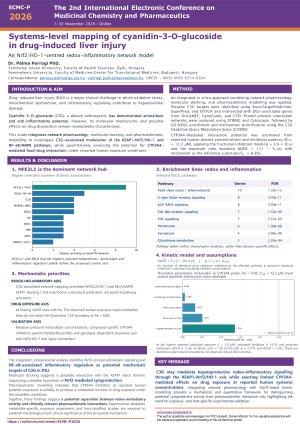
Background: Cyanidin-3-O-glucoside (C3G) is a prominent dietary anthocyanin abundant in dark berries, widely recognized for its potent antioxidant and anti-inflammatory properties. Despite its documented hepatoprotective potential, the comprehensive, systems-level molecular mechanisms by which C3G counteracts oxidative stress-mediated drug-induced liver injury (DILI) remain to be fully characterized.
Objective: This study aimed to systematically map the network pharmacology of C3G in the context of oxidative stress-induced inflammatory liver injury, with a specific focus on the Nrf2/HO-1/ROS antioxidant enzyme axis.
Methods: Candidate therapeutic targets of C3G were retrieved from public chemogenomic databases and intersected with disease-associated genes specific to oxidative stress and liver injury. A comprehensive protein–protein interaction (PPI) network was constructed, followed by topological hub gene analysis and GO/KEGG pathway enrichment profiling. To prioritize mechanistically relevant targets, a custom C3G Oxidative Stress Modulation Score was implemented. Structural interactions were further evaluated via molecular docking simulations against the KEAP1 repressor protein.
Results: The integrated network topology successfully identified NFE2L2 (Nrf2), KEAP1, HMOX1 (HO-1), NQO1, SOD2, CAT, GPX1, GCLC, RELA, and mitogen-activated protein kinase (MAPK)-related signaling proteins as central functional nodes. These targets directly link C3G exposure to cellular antioxidant defenses and the modulation of redox-sensitive inflammatory stress pathways.
Conclusion: This study establishes a systems-level pharmacology model demonstrating that cyanidin-3-O-glucoside effectively attenuates oxidative stress-mediated liver injury. This hepatoprotective effect is achieved through the coordinated activation of the Nrf2/HO-1 signaling axis, enhancement of downstream ROS detoxification enzymes, and suppression of inflammatory cascades.
Keywords
Cyanidin-3-O-glucoside
Network pharmacology
Drug-induced liver injury
Oxidative stress
Nrf2/HO-1 pathway.
Poster
IECP_Poster_Porrogi_submit.pdf
Polyphenolic Content and In Vitro Anti-Inflammatory Activity of Leaf Fractions from a Bulgarian Fig Cultivar (Ficus carica L.)
Preclinical Evaluation of UNIM-H and UNIM-R Polyherbal Formulations for the Management of Experimental Arthritis