Event submissions
EventsThe 2nd International Electronic Conference on Medicinal Chemistry and Pharmaceutics
Published
This submission belongs to the session S4. Natural Products and Biopharmaceuticals of the event The 2nd International Electronic Conference on Medicinal Chemistry and Pharmaceutics
Published date
28 Oct, 2026
Academic Editor
 Francisco Javier Otero Espinar
Contribution&Funding
Funding: The authors are grateful to the Fundação para a Ciência e Tecnologia (FCT) for their financial support through the projects with DOIs 10.54499/ UIDP/04567/2020 and 10.54499/UIDB/04567/2020 awarded to CBIOS, Portugal.
Citation
Vera M. S. Isca, Rebeca André, Marcia Santos Filipe, Ahmed Hussein, Patrícia Rijo, Natural Strategies for Skin Health: Bioactivity Profiling of Plectranthus Species with Antimicrobial and Skin-Related Enzyme Inhibitory Activities, in Proceedings of The 2nd International Electronic Conference on Medicinal Chemistry and Pharmaceutics, 1 November–30 November 2026, MDPI: Basel, Switzerland
Share
Email
Facebook
Twitter
LinkedIn
Natural Strategies for Skin Health: Bioactivity Profiling of Plectranthus Species with Antimicrobial and Skin-Related Enzyme Inhibitory Activities

Vera M. S. Isca 1,2

Rebeca André 1,3

Marcia Santos Filipe 1

Ahmed Hussein 4

Patrícia Rijo 1,2,3,5
1. CBIOS, Universidade Lusófona, Lisbon, Portugal
2. Instituto de Investigação do Medicamento (iMed.ULisboa), Faculdade de Farmácia, Universidade de Lisboa, Lisbon, Portugal
3. Centro de Quimica Estrutural, Institute of Molecular Sciences, Universidade de Lisboa, Lisbon, Portugal
4. Department of Chemistry, Cape Peninsula University of Technology, Cape Town, South Africa
5. Faculty of Biology and Environmental Protection, University of Lodz, Łódź, Poland
Abstract
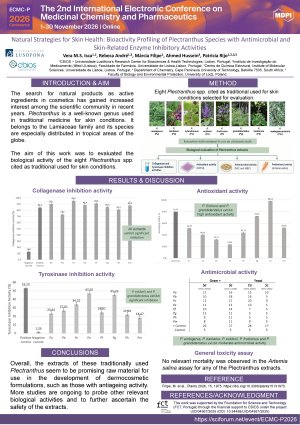
Plectranthus species have long been valued in traditional medicine for the management of skin-related disorders and are increasingly recognized as promising sources of bioactive compounds with dermatological relevance. Despite their widespread ethnopharmacological use, scientific validation of these properties remains scarce for several species. Therefore, the present study investigated the biological potential of eight Plectranthus species (P. ambiguus (Bolus) Codd, P. barbatus Andrews, P. cylindraceus (Hochst. ex Benth.) A.J. Paton, P. ecklonii Benth., P. fruticosus L'Hér., P. grandidentatus Gürke., P. hadiensis, P. madagascariensis Benth.) in order to substantiate their traditional uses and explore their suitability for dermatological applications.
To assess their biological activity, extracts were subjected to a comprehensive evaluation that included general toxicity testing using the Artemia salina lethality assay, antimicrobial screening, and the determination of inhibitory effects against enzymes closely associated with skin ageing and pigmentation processes, namely elastase, collagenase, and tyrosinase.
None of the tested extracts exhibited general toxicity in the Artemia salina model, indicating a favourable preliminary safety profile. Antimicrobial activity was mainly directed against Gram-positive bacteria, with Staphylococcus species showing the highest susceptibility. The enzymatic assays highlighted the anti-ageing potential of several extracts. Among them, P. ecklonii and P. cylindraceus displayed the most pronounced elastase inhibitory activity, with IC₅₀ values of 62.82 and 84.76 µg/mL, respectively. Notably, P. ecklonii demonstrated greater inhibitory capacity than the reference compound kojic acid (IC₅₀ = 75.55 µg/mL). In addition, extracts from P. ecklonii, P. grandidentatus, and P. fruticosus showed considerable collagenase inhibition, with IC₅₀ values ranging from 86.62 to 95.93 µg/mL, suggesting their potential to the preservation of skin structure. Collectively, these results provide scientific support for the ethnopharmacological use of Plectranthus species and reinforce their potential as valuable natural sources of bioactive compounds for skin care applications.
Keywords
Plectranthus
ethnopharmacological applications
antimicrobial activity
enzyme inhibitory activity
skin health
Poster
Plectranthus extracts.pdf
Synthesis and Antiproliferative Evaluation of a New Formyl Derivative of Carnosic Acid
Gastroprotective Effect of Costus afer Stem Methanol Extact on HCL/Ethanol-Induced Gastric Ulcer in Albino Rats