Event submissions
EventsThe 2nd International Electronic Conference on Medicinal Chemistry and Pharmaceutics
Published
This submission belongs to the session S4. Natural Products and Biopharmaceuticals of the event The 2nd International Electronic Conference on Medicinal Chemistry and Pharmaceutics
Published date
28 Oct, 2026
Academic Editor
 Alfredo Berzal-Herranz
Contribution&Funding
Conceptualization,
[Pavan Bhausaheb Udavant]
Methodology,
[Pavan Bhausaheb Udavant] ; [Vaishnavi Tushar Mahajan]
Resources,
[Vaishnavi Tushar Mahajan]
Writing - original draft,
[Vaishnavi Tushar Mahajan]
Writing - review,
[editing] ; [Pavan Bhausaheb Udavant]
Supervision,
[Pavan Bhausaheb Udavant]
Funding: --
Citation
Pavan Bhausaheb Udavant, Vaishnavi Tushar Mahajan, Network Pharmacology and Molecular Docking-Based Investigation of Tectoquinone Against Non-Alcoholic Fatty Liver Disease, in Proceedings of The 2nd International Electronic Conference on Medicinal Chemistry and Pharmaceutics, 1 November–30 November 2026, MDPI: Basel, Switzerland
Share
Email
Facebook
Twitter
LinkedIn
Network Pharmacology and Molecular Docking-Based Investigation of Tectoquinone Against Non-Alcoholic Fatty Liver Disease

Pavan Bhausaheb Udavant 1
Vaishnavi Tushar Mahajan 1
1. Pharmacology, MET'S Institute of Pharmacy Bhujbal Knowledge City, Adgaon, Nashik, Nashik, 422003, India
Abstract
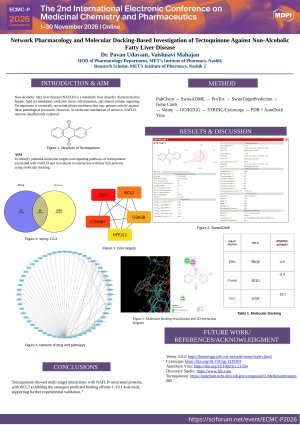
Background: Non-alcoholic fatty liver disease (NAFLD) is a metabolic liver disorder associated with hepatic lipid accumulation, oxidative stress, inflammation and altered cellular signaling. Tectoquinone, a naturally occurring phytoconstituent, may possess potential activity against these pathological processes; however, its molecular mechanism in NAFLD remains insufficiently explored.
Objective: The present study aimed to identify potential targets and signaling pathways of tectoquinone associated with NAFLD and to evaluate its interaction with key hub proteins using molecular docking.
Methods: SwissADME was used to evaluate the physicochemical and drug-likeness properties of tectoquinone, while ProTox-3.0 was employed for toxicity prediction. Potential drug targets were obtained from SwissTargetPrediction, and NAFLD-associated targets were retrieved from GeneCards. Venny analysis identified 44 common targets between tectoquinone and NAFLD. Gene Ontology and KEGG pathway enrichment analyses were performed, followed by construction of a drug–pathway–gene network using Cytoscape. Network analysis identified five major hub targets: ESR1, CTNNB1, BCL2, NFE2L2 and GSK3B. Molecular docking was subsequently performed with selected hub proteins.
Results: Tectoquinone showed favorable drug-likeness characteristics and high gastrointestinal absorption, with no major toxicity predicted in the evaluated ProTox endpoints. Enrichment analysis indicated involvement of multiple pathways related to metabolic regulation, lipid metabolism, inflammation and cellular signaling. Molecular docking demonstrated binding affinities of −10.0 kcal/mol with BCL2, −6.9 kcal/mol with CTNNB1, and approximately 0.0 kcal/mol with ESR1. Among the evaluated proteins, BCL2 exhibited the strongest predicted binding affinity (−10.0 kcal/mol).
Conclusion: These findings suggest that tectoquinone may interact with multiple NAFLD-associated targets, with BCL2 emerging as the most promising docked target, warranting further experimental validation.
Keywords
Tectoquinone; NAFLD; Network pharmacology; Molecular docking; Cytoscape; BCL2; CTNNB1; NFE2L2.
Poster
NP_Poster_Polished.pdf
Isolation and Screening of Bacteria with Biotechnological Potential from Permafrost-Associated Soils of Northern Pakistan
SKF7® Attenuates Lipid Accumulation in HepG2 Cells: Potential Implications for Menopause-Associated Metabolic Dysfunction