Event submissions
EventsThe 2nd International Electronic Conference on Medicinal Chemistry and Pharmaceutics
Published
This submission belongs to the session S4. Natural Products and Biopharmaceuticals of the event The 2nd International Electronic Conference on Medicinal Chemistry and Pharmaceutics
Published date
28 Oct, 2026
Academic Editor
 Maria Emília Sousa
Contribution&Funding
Conceptualization,
[Maria Pilar Vinardell] ; [Montse Mitjans Arnal] ; [Judit Camargo] ; [Adriana Solange Maddaleno]
Methodology,
[Adriana Solange Maddaleno] ; [Montse Mitjans Arnal]
Formal analysis,
[Adriana Solange Maddaleno] ; [Montse Mitjans Arnal] ; [Maria Pilar Vinardell]
Investigation,
[Adriana Solange Maddaleno] ; [Montse Mitjans Arnal] ; [Maria Pilar Vinardell] ; [Judit Camargo]
Resources,
[Judit Camargo]
Data curation,
[Adriana Solange Maddaleno] ; [Montse Mitjans Arnal]
Writing - original draft,
[Adriana Solange Maddaleno] ; [Montse Mitjans Arnal]
Writing - review,
[editing] ; [Maria Pilar Vinardell] ; [Adriana Solange Maddaleno] ; [Montse Mitjans Arnal]
Supervision,
[Judit Camargo] ; [Montse Mitjans Arnal]
Project administration,
[Judit Camargo]
Funding acquisition,
[Judit Camargo] ; [Montse Mitjans Arnal]
Funding: Project 2019 DI 0037 funded by AGAUR
Citation
Adriana Solange Maddaleno, Maria Pilar Vinardell, Judit Camargo, Montse Mitjans Arnal, Assessment of antioxidant activity of Phloretin and Neohesperidin Dihydrochalcone and their mixture using New Approach Methodologies (NAMs), in Proceedings of The 2nd International Electronic Conference on Medicinal Chemistry and Pharmaceutics, 1 November–30 November 2026, MDPI: Basel, Switzerland
Share
Email
Facebook
Twitter
LinkedIn
Assessment of antioxidant activity of Phloretin and Neohesperidin Dihydrochalcone and their mixture using New Approach Methodologies (NAMs)

Adriana Solange Maddaleno 1

Maria Pilar Vinardell 1
Judit Camargo 2
Montse Mitjans Arnal 1
1. Biochemistry and Physiology, Universitat de Barcelona, Barcelona, 08028, Spain
2. Executive Office, Roka Furadada S.L., Barcelona, 08042, Spain
Abstract
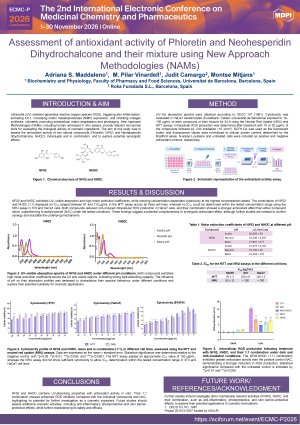
Ultraviolet (UV) radiation generates reactive oxygen species (ROS), triggering skin inflammation, activating AP-1, increasing matrix metalloproteinase (MMP) expression, and inhibiting collagen synthesis, ultimately promoting extracellular matrix degradation and photoaging. New Approach Methodologies (NAMs), including human cell-based in vitro assays, provide relevant non-animal tools for evaluating the biological activity of cosmetic ingredients. The aim of this study was to assess the antioxidant of two natural compounds (Phloretin, NF02; and Neohesperidin dihydrochalcone, NHDC), individually and in combination, and to investigate possible synergistic effects. UV-Vis absorption spectra were obtained according to OECD 101 (1981). Cytotoxicity was evaluated in HaCaT keratinocytes (Eucellbank, Celltec–Universitat de Barcelona) exposed to 10–100 µg/mL of each compound or their mixture for 24 h using the Neutral Red Uptake (NRU) and MTT assays. Intracellular ROS production was determined after treatment with 10 or 20 µg/mL of the compounds followed by UVA irradiation (10 J/cm²). DCFH-DA was used as the fluorescent probe, and fluorescence values were normalized to cellular protein content determined by the Bradford assay. N-acetyl-L-cysteine and untreated cells were included as positive and negative antioxidant controls, respectively. MTT results showed an IC50 of approximately 100 µg/mL, whereas no IC50 could be determined with the NRU assay. All compounds exhibited high molar extinction coefficients. Both individual compounds and their combination significantly reduced UVA-induced ROS production, with the mixture producing the greatest inhibition, suggesting a synergistic antioxidant effect. These findings support the usefulness of NAMs for the characterization of bioactive cosmetic ingredients.
Keywords
in vitro
antioxidants
Natural products
cell assay
NAMs
Poster
Maddaleno_et_al_2026.pdf
Antioxidant Potential of Oil Shrimp Shells Extracts
Licochalcone A Attenuates Acute Lung Injury through Modulation of STING Signaling and Mitochondrial Quality Control