Event submissions
EventsThe 2nd International Electronic Conference on Medicinal Chemistry and Pharmaceutics
Published
This submission belongs to the session S4. Natural Products and Biopharmaceuticals of the event The 2nd International Electronic Conference on Medicinal Chemistry and Pharmaceutics
Published date
28 Oct, 2026
Academic Editor
 Maria Emília Sousa
Contribution&Funding
Conceptualization,
[Silvana Alfei] ; [Cinzia Domenicotti] ; [Barbara Marengo]
Methodology,
[Cinzia Domenicotti] ; [Barbara Marengo]
Software,
[Cinzia Domenicotti] ; [Barbara Marengo]
Validation,
[Barbara Marengo]
Formal analysis,
[Silvana Alfei] ; [Barbara Marengo]
Investigation,
[Barbara Marengo] ; [Silvana Alfei]
Resources,
[Cinzia Domenicotti]
Data curation,
[Barbara Marengo] ; [Silvana Alfei]
Writing - original draft,
[Silvana Alfei]
Writing - review,
[editing] ; [Silvana Alfei] ; [Barbara Marengo]
Supervision,
[Silvana Alfei] ; [Cinzia Domenicotti]
Project administration,
[Silvana Alfei] ; [Cinzia Domenicotti]
Funding: --
Citation
Silvana Alfei, Barbara Marengo, Cinzia Domenicotti, Minimal Concentrations of a Chemically Modified Triterpene Derivative of Ursolic Acid (UA) Rapidly Exterminate MDR HR-NB HTLA Cells, Outperforming UA and Etoposide , in Proceedings of The 2nd International Electronic Conference on Medicinal Chemistry and Pharmaceutics, 1 November–30 November 2026, MDPI: Basel, Switzerland
Share
Email
Facebook
Twitter
LinkedIn
Minimal Concentrations of a Chemically Modified Triterpene Derivative of Ursolic Acid (UA) Rapidly Exterminate MDR HR-NB HTLA Cells, Outperforming UA and Etoposide

Silvana Alfei 1

Barbara Marengo 2

Cinzia Domenicotti 2
1. Pharmacy, University of Genoa, Genova, 16148, Italy
2. DIMES, University of Genoa, Genova, 16148, Italy
Abstract
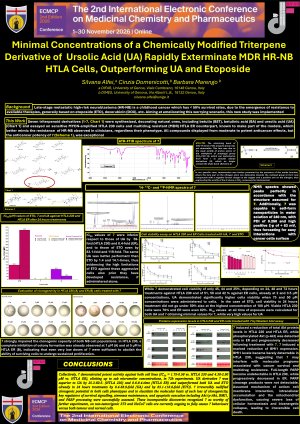
Late-stage metastatic high-risk neuroblastoma (HR-NB) childhood cancer has < 50% survival rates, due to the emergence of resistance to available therapies, generally based on etoposide (ETO), doxorubicin (DOX), etc. Aiming at ameliorating this worrying scenario, 7 triterpenoid derivatives (1-7) were synthesized, decorating betulin (BET), betulinic acid (BA) and ursolic acid (UA). They were essayed on sensitive MYCN-amplified HTLA 230 cells and multidrug resistant (MDR) HTLA ER counterpart, known to be the most aggressive forms of HR-NB, regardless their phenotype. All compounds displayed from moderate to potent anticancer effects, but the anticancer potency of UA derivative 7, was exceptional. Specifically, 7 demonstrated potent activity against both cell lines (IC50 = 1.75-0.58 vs. HTLA 230 and 4.30-2.90 µM vs. HTLA ER), eliciting up to sub micromolar concentrations, in 72h experiments. UA derivative 7 was superior to UA by 25.3-60.5- (HTLA 230) and 8.6-9.4-time (HTLA ER), and outperformed both UA and ETO already in 24h treatments by 8.4-58.9-fold (UA) and by 83.1-118.8-fold (ETO). Since, these incomparable discoveries recognised 7 as worthy of further experiments, clonogenicity tests, kinases phosphorylation investigations were performed. Clonogenicity was fully suppressed at all concentration tested in HTLA 230, while at the minimal concentration tested in HTLA ER, while kinase phosphorilation tests and the quantification of other markers evidenced that cytotoxicity of 7 was based on the inhibition of the AkT kinase system, due to the presence of acetylenic triple bond.
Keywords
high-risk NB (HR-NB); natural triterpenoids; synthetic triterpenes; nanovesicles; cell viability; clonogenicity; Akt and ERK1/2 kinase system
Poster
POSTER_ALFEI_unige.pdf
Phytochemical Screening, Chromatographic Profiling and Bioactivity Evaluation of Gardenia fosbergii Fruit Extract
Natural Product-Based Topical Formulation for Burn Wound Healing: A Controlled Study in a Murine Model