Event submissions
EventsThe 2nd International Electronic Conference on Medicinal Chemistry and Pharmaceutics
Published
This submission belongs to the session S4. Natural Products and Biopharmaceuticals of the event The 2nd International Electronic Conference on Medicinal Chemistry and Pharmaceutics
Published date
28 Oct, 2026
Academic Editor
 Alfredo Berzal-Herranz
Contribution&Funding
Conceptualization,
[Hediye Akhlaghi ]
Methodology,
[Abolfazl Rahmandoost ] ; [Hediye Akhlaghi ] ; [Atena maleki Sadeghi ]
Software,
[Abolfazl Rahmandoost ] ; [Hediye Akhlaghi ]
Validation,
[Abolfazl Rahmandoost ] ; [Atena maleki Sadeghi ]
Formal analysis,
[Abolfazl Rahmandoost ] ; [Sina Etminan ] ; [Ayda Shirgir ] ; [Atena maleki Sadeghi ] ; [Parinaz rezazadeh goli ]
Investigation,
[Parinaz rezazadeh goli ] ; [Atena maleki Sadeghi ] ; [Ayda Shirgir ] ; [Sina Etminan ]
Resources,
[Parinaz rezazadeh goli ] ; [Ayda Shirgir ] ; [Sina Etminan ]
Data curation,
[Parinaz rezazadeh goli ] ; [Sina Etminan ]
Writing - original draft,
[Seyed Sina Sabbaghi]
Writing - review,
[editing] ; [Seyed Sina Sabbaghi]
Visualization,
[Seyed Sina Sabbaghi]
Supervision,
[Seyed Sina Sabbaghi]
Project administration,
[Seyed Sina Sabbaghi]
Funding acquisition,
[Seyed Sina Sabbaghi]
Funding: Islamic Azad University & Personal Funding
Citation
Seyed Sina Sabbaghi, Hediye Akhlaghi , Parinaz rezazadeh goli , Atena maleki Sadeghi , Ayda Shirgir , Sina Etminan , Abolfazl Rahmandoost , Natural Product-Based Topical Formulation for Burn Wound Healing: A Controlled Study in a Murine Model, in Proceedings of The 2nd International Electronic Conference on Medicinal Chemistry and Pharmaceutics, 1 November–30 November 2026, MDPI: Basel, Switzerland
Share
Email
Facebook
Twitter
LinkedIn
Natural Product-Based Topical Formulation for Burn Wound Healing: A Controlled Study in a Murine Model

Seyed Sina Sabbaghi 1

Hediye Akhlaghi 2
Parinaz rezazadeh goli 2
Atena maleki Sadeghi 3
Ayda Shirgir 4
Sina Etminan 2
Abolfazl Rahmandoost 5
1. Department of Immunology and Oncology, Faculty of Veterinary Medicine, Islamic Azad University-Garmsar Branch, Garmsar, Iran
2. Faculty of Veterinary Medicine, University of Garmsar, Semnan, Iran
3. Faculty of Pharmacy, Pharmaceutical Sciences Branch, Islamic Azad University, Tehran, Iran
4. School of Medicine, Tehran Medical Sciences Branch, Islamic Azad University, Tehran, Iran
5. Department of Medical-Surgical Nursing, School of Nursing and Midwifery, Tehran University of Medical Sciences (TUMS), Tehran, Iran
Abstract
Background: Natural products and multicomponent topical formulations are increasingly investigated for tissue repair, but their efficacy compared with established treatments remains insufficiently characterised. This study evaluated the wound-healing effects of a traditional multicomponent ointment compared with silver sulfadiazine (SSD) in a standardised murine model of second-degree burn injury.
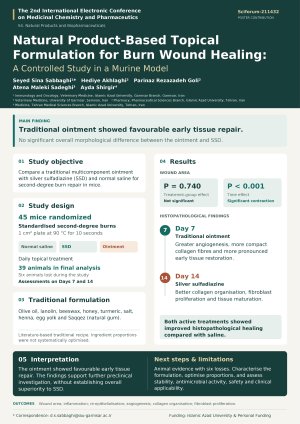
Methods: Standardised second-degree burns were induced in 45 mice using a 1 cm² plate heated to 90 °C for 10 s. Animals were randomly allocated to normal saline, SSD, or a traditional topical ointment containing olive oil, lanolin, beeswax, honey, turmeric, salt, henna, egg yolk, and Saqqez (natural gum). The ointment composition was based on a traditional recipe described in the literature, rather than systematic optimisation of ingredient proportions. Treatments were administered daily. Following the loss of six animals, 39 animals were included in the final analysis. Wound area and histopathological parameters, including inflammation, re-epithelialisation, angiogenesis, collagen organisation, and fibroblast proliferation, were evaluated on Days 7 and 14.
Results: Treatment group did not significantly affect wound area overall (P = 0.740), whereas wound contraction progressed significantly over time (P < 0.001). Both SSD and the traditional ointment showed improved histopathological healing compared with saline. On Day 7, the ointment was associated with greater angiogenesis, more compact collagen fibres, and more pronounced early tissue restoration. By Day 14, SSD showed better collagen organisation, fibroblast proliferation, and tissue maturation. No significant overall morphological differences were observed between the two active-treatment groups.
Conclusions: The traditional multicomponent ointment showed favourable histopathological features of burn wound repair, particularly during the early healing phase, although no significant overall differences were detected between the active treatments. These findings support further investigation of the preparation, including physicochemical characterisation, optimisation of ingredient proportions, and assessment of stability, antimicrobial activity, safety, and clinical applicability.
Keywords
Natural products; Topical formulation; Wound healing; Burn injury; Pharmaceutical formulation
Poster
Burn_Wound_Poster_A1.pdf
Minimal Concentrations of a Chemically Modified Triterpene Derivative of Ursolic Acid (UA) Rapidly Exterminate MDR HR-NB HTLA Cells, Outperforming UA and Etoposide
Development of natural chlorin-based photoactivatable Pt(II) and Pt(IV) complexes.