Event submissions
EventsThe 2nd International Electronic Conference on Medicinal Chemistry and Pharmaceutics
Published
This submission belongs to the session S4. Natural Products and Biopharmaceuticals of the event The 2nd International Electronic Conference on Medicinal Chemistry and Pharmaceutics
Published date
28 Oct, 2026
Academic Editor
 Alfredo Berzal-Herranz
Contribution&Funding
Funding: This work was supported by the Ministry of Science and Higher Education of the Russian Federation under state assignment No. FSFZ-2025-0020.
Citation
Evgeniya Borzhitskaya, Ekaterina Plotnikova, Leonid Martinov, Petr Ostroverkhov, Mikhail A. Grin, Development of natural chlorin-based photoactivatable Pt(II) and Pt(IV) complexes., in Proceedings of The 2nd International Electronic Conference on Medicinal Chemistry and Pharmaceutics, 1 November–30 November 2026, MDPI: Basel, Switzerland
Share
Email
Facebook
Twitter
LinkedIn
Development of natural chlorin-based photoactivatable Pt(II) and Pt(IV) complexes.

Evgeniya Borzhitskaya 1
Ekaterina Plotnikova 2,3
Leonid Martinov 1
Petr Ostroverkhov 1
Mikhail A. Grin 1
1. Department of Chemistry and Technology of Biologically Active Compounds, Medicinal and Organic Chemistry, Institute of Fine Chemical Technologies, MIREA – Russian Technological University, Moscow, Russia
2. Department of Chemistry and Technology of Biologically Active Compounds, Medicinal and Organic Chemistry, Institute of Fine Chemical Technologies, MIREA – Russian Technological University, Moscow, Russia
3. P.Hertsen Moscow Oncology Research Institute-Branch of the National Medical Research Radiological Centre of the Ministry of Health of the Russian Federation, -, Moscow, Russia
Abstract
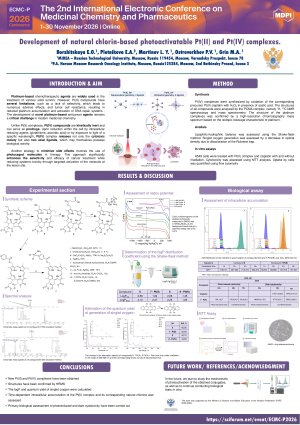
Platinum-based chemotherapeutic agents are widely used in the treatment of various solid tumors. However, Pt(II) compounds have a number of limitations, such as insufficient selectivity of accumulation and action, which leads to numerous adverse effects. It is also known about drug resistance of tumor cells, resulting in reduced platinum accumulation and activation of DNA repair systems. The development of novel platinum-based anticancer agents remains a critical challenge in modern medicinal chemistry.
Unlike Pt(II) complexes, Pt(IV) compounds are kinetically inert and can serve as prodrugs. Upon reduction within the cell by intracellular reducing agents (glutathione, ascorbic acid) or by exposure to light of a specific wavelength, Pt(IV) complex releases not only the cytotoxic moiety but also two axial ligands, which may themselves possess biological activity.
Another strategy to minimize side effects involves the use of photocaged molecules in therapy. This approach significantly enhances the selectivity and efficacy of cancer treatment while reducing systemic toxicity through targeted activation of the molecule at the lesion site.
This study focuses on the development of photoactivatable Pt(II) and Pt(IV) complexes using natural chlorin-based photosensitizers as vector molecules characterized by high affinity for tumor tissue. The obtained compounds were analyzed using a set of physicochemical methods (NMR spectroscopy, mass-spectrometry, studies on determining the quantum yield of singlet oxygen and LogP), and their structures were reliably confirmed by high‑resolution chromatography–mass spectrometry. At the current stage, primary in vitro cytotoxicity studies and intracellular accumulation are being evaluated using the A549 lung adenocarcinoma cell line.
Keywords
photopharmacology
photodynamic therapy
cisplatin
platinum(IV) prodrug
Combination therapy
Poster
постер.pdf
Natural Product-Based Topical Formulation for Burn Wound Healing: A Controlled Study in a Murine Model
Dynamics of accumulation of phenolic compounds and flavonoids in the leaves of two apricot cultivars (Prunus armeniaca L.) during the vegetation period.