Event submissions
EventsThe 2nd International Electronic Conference on Medicinal Chemistry and Pharmaceutics
Published
This submission belongs to the session S4. Natural Products and Biopharmaceuticals of the event The 2nd International Electronic Conference on Medicinal Chemistry and Pharmaceutics
Published date
28 Oct, 2026
Academic Editor
 Maria Emília Sousa
Citation
Andranik Kutsanyan, Liudas Ivanauskas, Mindaugas Marksa, Victoriya A. Georgiyants, Dynamics of accumulation of phenolic compounds and flavonoids in the leaves of two apricot cultivars (Prunus armeniaca L.) during the vegetation period., in Proceedings of The 2nd International Electronic Conference on Medicinal Chemistry and Pharmaceutics, 1 November–30 November 2026, MDPI: Basel, Switzerland
Share
Email
Facebook
Twitter
LinkedIn
Dynamics of accumulation of phenolic compounds and flavonoids in the leaves of two apricot cultivars (Prunus armeniaca L.) during the vegetation period.

Andranik Kutsanyan 1
Liudas Ivanauskas 1
Mindaugas Marksa 1
Victoriya A. Georgiyants 2
1. Analytical and Toxicological Chemistry Department, Lithuanian University of Health Sciences, Kaunas, 44307, Lithuania
2. Pharmaceutical Chemistry, National University of Pharmacy, Kharkiv, 61168, Ukraine
Abstract
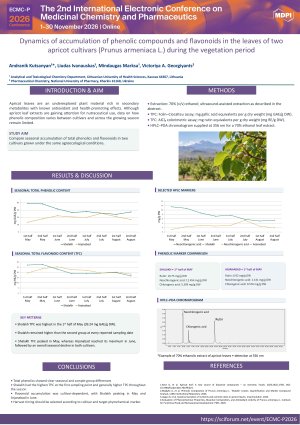
Background. Apricot (Prunus armeniaca L.) leaves are an underexplored plant material rich in secondary metabolites with known antioxidant and health-promoting effects. Although apricot leaf extracts are gaining attention for nutraceutical use, data on how phenolic composition varies between cultivars and across the growing season remain limited. Objective. This study investigated the seasonal accumulation patterns of total phenolics and flavonoids in leaves of two P. armeniaca cultivars grown under the same agroecological conditions. Materials and Methods. Leaf samples from two apricot cultivars were collected every two weeks from a single orchard in Armenia throughout the vegetation season (eight sampling points per cultivar). Phenolic compounds were extracted with 70% (v/v) ethanol using ultrasound-assisted extraction. Total phenolic content (TPC) was measured spectrophotometrically with the Folin–Ciocalteu reagent and expressed as mg gallic acid equivalents per g dry weight (mg GAE/g DW). Total flavonoid content (TFC) was determined by the aluminum chloride colorimetric method and expressed as mg rutin equivalents per g dry weight (mg RE/g DW).
Results. TPC ranged from 13.27 to 37.24 mg GAE/g DW, with the highest values observed during fruit development in May. TFC varied between 16.62 and 27.06 mg RE/g DW, also peaking in May. Significant differences between cultivars were found (p<0.05). Cultivar Shalakh showed higher total phenolic content than Tabarza, with a peak in May. In contrast, Tabarza reached maximal phenolic levels in late July, after fruiting. For flavonoids, Shalakh had higher levels only at the start of fruiting, while Tabarza accumulated more flavonoids overall, with a peak during fruit development in June. Conclusion. Apricot leaf phenolics show clear seasonal and cultivar-specific variation, with early-to-mid vegetation stages offering the best harvest window for maximizing bioactive compound yield. These results support the use of apricot leaves as a sustainable raw material for dietary supplements and functional foods.
Keywords
Keywords: Prunus armeniaca
phenolic compounds
flavonoids
seasonal variation
cultivar differences
Poster
Poster sciforum Kutsanyan.pdf
Development of natural chlorin-based photoactivatable Pt(II) and Pt(IV) complexes.
Investigating the Potential of Morus alba and Morus nigra Extracts in Mitigating Anxiety in the Scopolamine-Treated Zebrafish Model