Event submissions
EventsThe 2nd International Electronic Conference on Medicinal Chemistry and Pharmaceutics
Published
This submission belongs to the session S4. Natural Products and Biopharmaceuticals of the event The 2nd International Electronic Conference on Medicinal Chemistry and Pharmaceutics
Published date
28 Oct, 2026
Academic Editor
 Mary J. Meegan
Citation
Maria Crina Isac, Lucian Hritcu, Alexandra-Mara Cimpanu, Investigating the Potential of Morus alba and Morus nigra Extracts in Mitigating Anxiety in the Scopolamine-Treated Zebrafish Model, in Proceedings of The 2nd International Electronic Conference on Medicinal Chemistry and Pharmaceutics, 1 November–30 November 2026, MDPI: Basel, Switzerland
Share
Email
Facebook
Twitter
LinkedIn
Investigating the Potential of Morus alba and Morus nigra Extracts in Mitigating Anxiety in the Scopolamine-Treated Zebrafish Model

Maria Crina Isac 1

Lucian Hritcu 1

Alexandra-Mara Cimpanu 1
1. Department of Biology, Alexandru Ioan Cuza University of Iași, Iași , 700506, Romania
Abstract
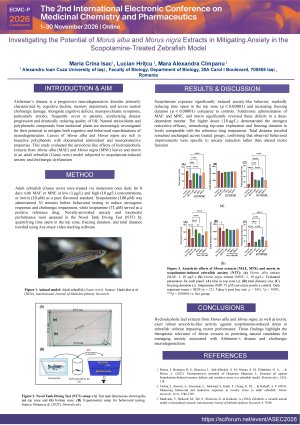
Cognitive decline, memory impairment, and severe deterioration of the central cholinergic system characterize Alzheimer’s disease. Alongside these deficits, patients frequently experience neuropsychiatric symptoms, particularly anxiety, which accelerates disease progression. Natural polyphenols are increasingly investigated to mitigate both cognitive and behavioral manifestations of neurodegeneration. Leaves of Morus alba and Morus nigra contain bioactive compounds with documented antioxidant and neuroprotective properties. Phytochemical profiling by RP-UHPLC-PDA analysis revealed polyphenols and flavonoids in both hydroalcoholic extracts, with Morus nigra showing higher overall polyphenol levels. Key identified compounds included chlorogenic acid, caffeic acid, hyperoside, luteolin-7-glucoside, and t-ferulic acid. This study evaluated the anxiolytic effect of hydroalcoholic leaf extracts (MAE and MNE) and morin in adult zebrafish (Danio rerio) with scopolamine-induced cholinergic dysfunction. Zebrafish were exposed daily via immersion for eight days to low (1 µg/L) and high (10 µg/L) concentrations of MAE or MNE, or morin (20 µM). Scopolamine (100 µM) was administered thirty minutes prior to behavioral testing, with imipramine (71 µM) as positive control. Exploratory behavior and anxiety were quantified using the Novel Tank Diving Test (NTT). Scopolamine induced a sharp increase in anxiety, significantly reducing time in the top tank section (p < 0.00001) and prolonging freezing duration (p < 0.00001). Treatments reversed these deficits dose-dependently. Higher concentrations (MAE-H, MNE-H) restored exploratory activity to levels comparable with imipramine. Total distance traveled remained unchanged, confirming specific anxiety reduction without motor impairment. In conclusion, Morus alba and Morus nigra extracts exhibit pronounced anxiolytic activity, representing relevant therapeutic options for anxiety associated with cholinergic neurodegeneration.
Keywords
Morus alba
Morus nigra
morin
Danio rerio
anxiety
scopolamine
Novel Tank Diving Test
Poster
Sciforum_210767.pdf
Dynamics of accumulation of phenolic compounds and flavonoids in the leaves of two apricot cultivars (Prunus armeniaca L.) during the vegetation period.
Mechanisms of Naoxueshu in spontaneous intracerebral hemorrhage: an integrative analysis of gut microbiota and network pharmacology