Event submissions
EventsThe 2nd International Electronic Conference on Medicinal Chemistry and Pharmaceutics
Published
This submission belongs to the session S4. Natural Products and Biopharmaceuticals of the event The 2nd International Electronic Conference on Medicinal Chemistry and Pharmaceutics
Published date
28 Oct, 2026
Academic Editor
 Maria Emília Sousa
Citation
Antenor Correia da Silva Júnior, Carlos Augusto de Senna Azevedo, Ingryd Carolly de Oliveira Medeiros, Giovanna Isabelle Camilo, Dayane Aurora dos Santos Fernandes, José Maria Sombra Júnior, Eveline Matias Bezerra, Roner Ferreira da Costa, Beyond Bioactivity: Conformational Effects on the Electronic and Optical Properties of the Anti-Inflammatory Alkaloid Oleradiazahyde, in Proceedings of The 2nd International Electronic Conference on Medicinal Chemistry and Pharmaceutics, 1 November–30 November 2026, MDPI: Basel, Switzerland
Share
Email
Facebook
Twitter
LinkedIn
Beyond Bioactivity: Conformational Effects on the Electronic and Optical Properties of the Anti-Inflammatory Alkaloid Oleradiazahyde

Antenor Correia da Silva Júnior 1
Carlos Augusto de Senna Azevedo 1
Ingryd Carolly de Oliveira Medeiros 1
Giovanna Isabelle Camilo 1
Dayane Aurora dos Santos Fernandes 1
José Maria Sombra Júnior 1
Eveline Matias Bezerra 1
Roner Ferreira da Costa 1
1. Exact and Natural Sciences Center, Federal Rural University of the Semi-arid Region, Mossoró, 59625-900, Brazil
Abstract
Introduction
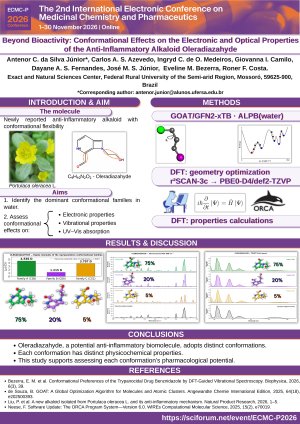
Oleradiazahyde is a recently reported alkaloid with anti-inflammatory activity. It was isolated from Portulaca oleracea, an edible and medicinal plant widely distributed in tropical and subtropical regions and long used in traditional medicine. The flexible hydroxyethyl substituent of oleradiazahyde raises a question concerning its molecular characterization: to what extent can a single geometry represent its electronic and optical behavior in aqueous solution? This study investigates the effects of conformational heterogeneity on these properties.
Methods
An extensive GOAT/GFN2-xTB/ALPB(water) search generated 268 candidate structures, which were clustered into nine representatives. These structures were optimized using r²SCAN-3c/SMD(water) and PBE0-D4/def2-TZVP/SMD(water), and both DFT levels produced the same energetic ordering. Harmonic frequency calculations verified the six lowest PBE0 conformers as minima. TD-PBE0/def2-TZVP calculations and natural transition orbital (NTO) analysis were performed for the three dominant conformational families.
Results
The six lowest conformers are distributed among three dominant families with estimated populations of approximately 75, 20, and 5%. Conformational variation substantially changes the molecular dipole moment, which ranges from 1.21 to 4.54 D, while the Kohn–Sham HOMO–LUMO gap varies only from 3.21 to 3.29 eV. The weak lowest singlet excitation occurs between 527 and 556 nm (f = 0.014–0.028). By contrast, a stronger fourth singlet transition remains between 279 and 283 nm (f = 0.306–0.326) and is dominated by a single NTO pair in all three families.
Conclusions
Conformational heterogeneity has a pronounced effect on the ground-state polarization of oleradiazahyde, but a more limited influence on its frontier-orbital gap and stronger UV transition. The results indicate that different electronic and optical properties respond differently to conformational rearrangement and provide an ensemble-based description of the physicochemical behavior of this recently identified bioactive natural product.
Keywords
Oleradiazahyde
Conformational Analysis
Density Functional Theory
Anti-Inflammatory Alkaloid
Poster
Sciforum-210696_BANNER___.pdf
Mechanisms of Naoxueshu in spontaneous intracerebral hemorrhage: an integrative analysis of gut microbiota and network pharmacology
Could Teas and Refreshing Beverages Based on Sage Help Prevent Gingivitis? An In Silico Molecular Docking Study