Event submissions
EventsThe 2nd International Electronic Conference on Medicinal Chemistry and Pharmaceutics
Published
This submission belongs to the session S4. Natural Products and Biopharmaceuticals of the event The 2nd International Electronic Conference on Medicinal Chemistry and Pharmaceutics
Published date
28 Oct, 2026
Academic Editor
 Maria Emília Sousa
Contribution&Funding
Conceptualization,
[Jelena Đorović Jovanović] ; [Violeta Jakovljevic] ; [Stevan Sofronijević] ; [Svetlana Jeremić]
Methodology,
[Jelena Đorović Jovanović] ; [Marko Antonijević] ; [Svetlana Jeremić]
Software,
[Marko Antonijević]
Validation,
[Stevan Sofronijević] ; [Violeta Jakovljevic]
Formal analysis,
[Svetlana Jeremić] ; [Jelena Đorović Jovanović] ; [Marko Antonijević]
Investigation,
[Svetlana Jeremić]
Resources,
[Svetlana Jeremić]
Data curation,
[Stevan Sofronijević] ; [Violeta Jakovljevic]
Writing - original draft,
[Jelena Đorović Jovanović] ; [Violeta Jakovljevic] ; [Svetlana Jeremić]
Visualization,
[Marko Antonijević] ; [Jelena Đorović Jovanović] ; [Svetlana Jeremić]
Supervision,
[Svetlana Jeremić]
Funding: This work was supported by the Serbian Ministry of Science, Technological Development and Innovation (Contract No. 451-03-34/2026-03/200252 and 451-03-33/2026-03/200378).
Citation
Svetlana Jeremić, Jelena Đorović Jovanović, Marko Antonijević, Violeta Jakovljevic, Stevan Sofronijević, Could Teas and Refreshing Beverages Based on Sage Help Prevent Gingivitis? An In Silico Molecular Docking Study, in Proceedings of The 2nd International Electronic Conference on Medicinal Chemistry and Pharmaceutics, 1 November–30 November 2026, MDPI: Basel, Switzerland
Share
Email
Facebook
Twitter
LinkedIn
Could Teas and Refreshing Beverages Based on Sage Help Prevent Gingivitis? An In Silico Molecular Docking Study

Svetlana Jeremić 1

Jelena Đorović Jovanović 2

Marko Antonijević 2
Violeta Jakovljevic 1
Stevan Sofronijević 2
1. Department of Natural and Mathematical Sciences, State University of Novi Pazar, Novi Pazar, 36300, Serbia
2. Department of Natural and Mathematical Sciences, Institute for Information Technologies Kragujevac, Kragujevac, 34000, Serbia
Abstract
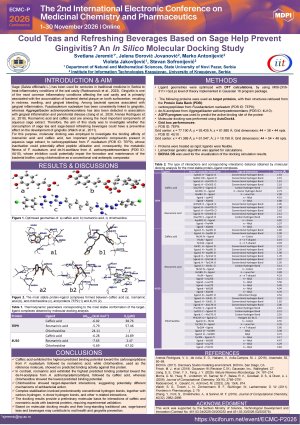
Sage (Salvia officinalis L.) has been used for centuries in traditional medicine in Serbia to treat inflammatory conditions of the oral cavity. Gingivitis is a common inflammatory condition primarily associated with bacterial dental plaque, causing redness, swelling, and gingival bleeding. Among bacteria associated with gingival inflammation, Fusobacterium nucleatum has been consistently linked to gingivitis, while Aggregatibacter actinomycetemcomitans has also been implicated.
Molecular docking was employed to investigate the binding affinity of rosmarinic acid and caffeic acid, two important polyphenolic compounds present in aqueous sage extract, to carboxypeptidase from F. nucleatum (PDB ID: 7EP9), whose inactivation could potentially affect peptide utilization and, consequently, the metabolic fitness of F. nucleatum, and de-N-acetilaza from A. actinomycetemcomitans (PDB ID: 4U10), whose inhibition could potentially impair the formation and maintenance of the bacterial biofilm, using chlorhexidine as a conventional oral antiseptic comparator.
The results revealed distinct predicted binding preferences. For 7EP9, caffeic acid showed the most favorable predicted binding potency (ΔGbind = −6.02 kcal mol⁻¹; Kᵢ = 38.76 µM), followed by rosmarinic acid (ΔGbind = −5.79 kcal mol⁻¹; Kᵢ = 57.46 µM), whereas chlorhexidine showed unfavorable binding (ΔGbind = +24.11 kcal mol⁻¹). For 4U10, rosmarinic acid showed the most favorable predicted binding potency (ΔGbind = −7.65 kcal mol⁻¹; Kᵢ = 2.47 µM), followed by caffeic acid (ΔGbind = −6.28 kcal mol⁻¹; Kᵢ = 24.89 µM) and chlorhexidine (ΔGbind = −5.69 kcal mol⁻¹; Kᵢ = 67.02 µM). Complex stabilization involved predominantly conventional hydrogen bonds, together with carbon–hydrogen, π-donor hydrogen bonds, and other π-related interactions.
The docking results provide a preliminary molecular basis for interactions of caffeic and rosmarinic acids with bacterial proteins, requiring experimental validation. Chlorhexidine showed target-dependent interactions, suggesting potentially different mechanisms of antibacterial action. Based on their long-standing traditional use, sage-based teas and beverages may contribute to oral health and gingivitis prevention.
Keywords
Rosmarinic acid; Caffeic acid; Gingivitis; Molecular docking
Poster
Poster-Could Teas and Refreshing Beverages Based on Sage Help Prevent Gingivitis - An In Silico Molecular Docking Study.pdf
Beyond Bioactivity: Conformational Effects on the Electronic and Optical Properties of the Anti-Inflammatory Alkaloid Oleradiazahyde
Exploring the Phytochemical and Anticancer Potential of Endophyte Daldinia eschscholtzii Isolated from Clausena excavata: An Integrated In Vitro and In Silico Approach