Event submissions
EventsThe 2nd International Electronic Conference on Medicinal Chemistry and Pharmaceutics
Published
This submission belongs to the session S4. Natural Products and Biopharmaceuticals of the event The 2nd International Electronic Conference on Medicinal Chemistry and Pharmaceutics
Published date
28 Oct, 2026
Academic Editor
 Mary J. Meegan
Contribution&Funding
Conceptualization,
[Nazia Hoque]
Methodology,
[Nurun Nahar] ; [Sk. Salman Araf]
Software,
[Nurun Nahar] ; [Sk. Salman Araf]
Validation,
[Nurun Nahar] ; [Nazia Hoque]
Formal analysis,
[Nazia Hoque]
Investigation,
[Nurun Nahar] ; [Sk. Salman Araf]
Writing - original draft,
[Nurun Nahar] ; [Sk. Salman Araf]
Writing - review,
[editing] ; [Nazia Hoque]
Supervision,
[Nazia Hoque]
Project administration,
[Nazia Hoque]
Funding acquisition,
[Nazia Hoque]
Funding: --
Citation
Nurun Nahar, Sk. Salman Araf, Nazia Hoque, Exploring the Phytochemical and Anticancer Potential of Endophyte Daldinia eschscholtzii Isolated from Clausena excavata: An Integrated In Vitro and In Silico Approach, in Proceedings of The 2nd International Electronic Conference on Medicinal Chemistry and Pharmaceutics, 1 November–30 November 2026, MDPI: Basel, Switzerland
Share
Email
Facebook
Twitter
LinkedIn
Exploring the Phytochemical and Anticancer Potential of Endophyte Daldinia eschscholtzii Isolated from Clausena excavata: An Integrated In Vitro and In Silico Approach

Nurun Nahar 1
Sk. Salman Araf 1
Nazia Hoque 1
1. Department of Pharmacy, East West University, Aftabnagar, Dhaka, 1212, Bangladesh
Abstract
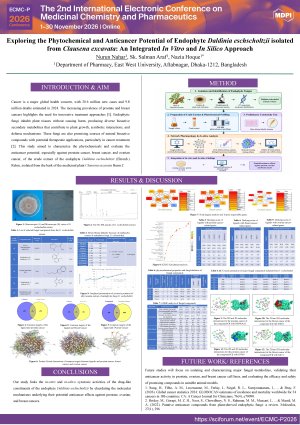
Endophytic fungi maintain symbiotic relationships with plants and produce diverse secondary metabolites with significant therapeutic potential. This study aimed to characterize the phytochemicals and evaluate the anticancer potential of the crude extract of the endophyte Daldinia eschscholtzii (Ehrenb.) Rehm, isolated from the bark of the medicinal plant Clausena excavata Burm.f. The endophytic fungus was identified using morphological, microscopic, and molecular (ITS sequencing) methods, and small-scale cultivation was performed following a standard isolation protocol to obtain the crude extract. Phytochemical profiling of the crude extract was performed by GC-MS, and the brine shrimp lethality bioassay was used to assess preliminary cytotoxicity. Further, major metabolites identified by GC-MS were subjected to a network pharmacology-based in-silico ADMET analysis to predict their potential molecular targets and molecular mechanisms associated with prostate, ovarian, and breast cancer. The fungal extract exhibited significant cytotoxicity in the brine shrimp lethality bioassay. A total of thirty-seven fungal metabolites were identified by GC-MS. Network pharmacology analysis identified 31, 24, and 53 common target genes shared by the five major fungal metabolites and prostate, ovarian, and breast cancer, respectively. The PPI network identified AKT1, EGFR, STAT3, ESR1, HSP90AA1, PPARG, PTGS2, and EP300 as highly potential targets. The common genes were significantly associated with GO-enriched biological processes and 155 KEGG pathways, including ovarian, prostate, and breast cancer, EGFR, and STAT. Further, molecular docking studies revealed docking scores ranging from -6.6 to -8 kcal/mol. Among them, 1,8-dimethoxynaphthalene, methylhexadecanoate, and 4-methoxy-1-naphthalenol exhibited promising binding affinities toward AKT1, ESR1, HSP90AA1, and PPARG. Moreover, these metabolites demonstrated drug-like properties by following Lipinski’s rule and favorable ADME profile with no predicted hepatotoxicity, nephrotoxicity, or cardiotoxicity. Our study links the in-vitro and in-silico cytotoxic activities of the drug-like constituents of the endophyte D. eschscholtzii by elucidating the molecular mechanisms underlying their potential anticancer effects against prostate, ovarian, and breast cancers.
Keywords
Clausena excavata
Daldinia eschscholtzii
GC-MS
anticancer
network pharmacology
Poster
Sciforum-210581-poster.pdf
Could Teas and Refreshing Beverages Based on Sage Help Prevent Gingivitis? An In Silico Molecular Docking Study
Fe₃O₄ nanoparticle-induced enhancement of phenolic acid and flavonoid content in cell suspension culture of Scrophularia striata Boiss.