Event submissions
EventsThe 2nd International Electronic Conference on Medicinal Chemistry and Pharmaceutics
Published
This submission belongs to the session S4. Natural Products and Biopharmaceuticals of the event The 2nd International Electronic Conference on Medicinal Chemistry and Pharmaceutics
Published date
28 Oct, 2026
Academic Editor
 Thierry Vandamme
Contribution&Funding
Conceptualization,
[Khadijeh Sabetpour] ; [Mohsen Sharifi]
Methodology,
[Khadijeh Sabetpour] ; [Reyhaneh Danaeipour]
Software,
[Khadijeh Sabetpour]
Validation,
[Mohsen Sharifi]
Formal analysis,
[Khadijeh Sabetpour]
Investigation,
[Khadijeh Sabetpour]
Resources,
[Khadijeh Sabetpour]
Writing - original draft,
[Khadijeh Sabetpour]
Writing - review,
[editing] ; [Vahid Niknam]
Supervision,
[Mohsen Sharifi]
Funding: no funding
Citation
Khadijeh Sabetpour, Mohsen Sharifi, Vahid Niknam, Reyhaneh Danaeipour, Fe₃O₄ nanoparticle-induced enhancement of phenolic acid and flavonoid content in cell suspension culture of Scrophularia striata Boiss., in Proceedings of The 2nd International Electronic Conference on Medicinal Chemistry and Pharmaceutics, 1 November–30 November 2026, MDPI: Basel, Switzerland
Share
Email
Facebook
Twitter
LinkedIn
Fe₃O₄ nanoparticle-induced enhancement of phenolic acid and flavonoid content in cell suspension culture of Scrophularia striata Boiss.

Khadijeh Sabetpour 1
Mohsen Sharifi 1
Vahid Niknam 2
Reyhaneh Danaeipour 1
1. Department of Plant Biology, Faculty of Biological Sciences, Tarbiat Modares University, Tehran, Iran
2. School of Biology, College of Science, Tehran, Iran
Abstract
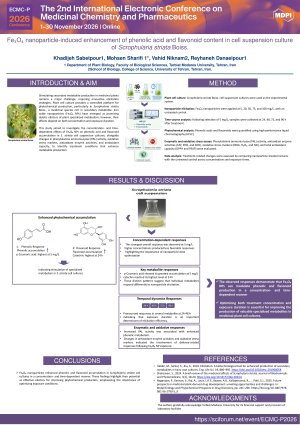
Stimulating secondary metabolite production in medicinal plants remains a major challenge, requiring innovative elicitation strategies. Plant cell culture provides a controlled platform for phytochemical production, particularly in Scrophularia striata Boiss., a medicinal species rich in secondary metabolite. Iron oxide nanoparticles (Fe₃O₄ NPs) are promising abiotic elicitors whose effects depend on concentration and exposure time. This study investigated the concentration- and time-dependent responses of S. striata cell suspension cultures to Fe₃O₄ NPs. Cells were exposed to different nanoparticle concentrations (5, 20, 50, 75, and 100 mg/L), followed by time-course analysis at the optimized concentration of 5 mg/L over 24-96 h. Phenolic acid and flavonoid profiles were quantified by HPLC, while antioxidant enzyme activities, oxidative stress markers, and total antioxidant capacity were evaluated. Fe₃O₄ NPs enhanced phenolic and flavonoid accumulation, accompanied by increased phenylalanine ammonia-lyase activities. p-coumaric acid showed the greatest increase at 5 mg/L, suggesting enhanced phenylpropanoid metabolism and PAL activity, whereas catechin exhibited the strongest flavonoid response, reaching its highest accumulation at 24 h, particularly at 5 mg/L. Other metabolites showed distinct concentration and time-dependent patterns, with several reaching maxima during 24-48 h, highlighting this period as a critical response window. The greatest efficacy occurred at 5 mg/L, where Fe₃O₄ NPs promoted defense-related metabolic responses without evident oxidative damage, consistent with a hormetic dose-response pattern. In contrast, higher concentrations increased oxidative stress and reduced biosynthetic activity. These findings highlight importance of optimizing nanoparticle concentration and exposure duration to enhance the sustainable production of valuable specialized metabolites in S. striata cultures.
Keywords
Cell suspension cultures; Flavonoid; Hormesis; Iron oxide nanoparticles; Phenolic acid; Scrophularia striata Boiss.; Secondary metabolites
Poster
Sciforum-210779.pdf
Exploring the Phytochemical and Anticancer Potential of Endophyte Daldinia eschscholtzii Isolated from Clausena excavata: An Integrated In Vitro and In Silico Approach
In Silico Investigation of Naringenin Binding to COX-2: Docking, Molecular Dynamics, and Comparison with COX-1